Methodology for Transmission-Line Fault Detection, Classification, Location, and Protection Coordination Using PMU-Assisted Distance Relaying
DOI:
https://doi.org/10.65521/ijaeee.v5i1.4586Keywords:
Abstract
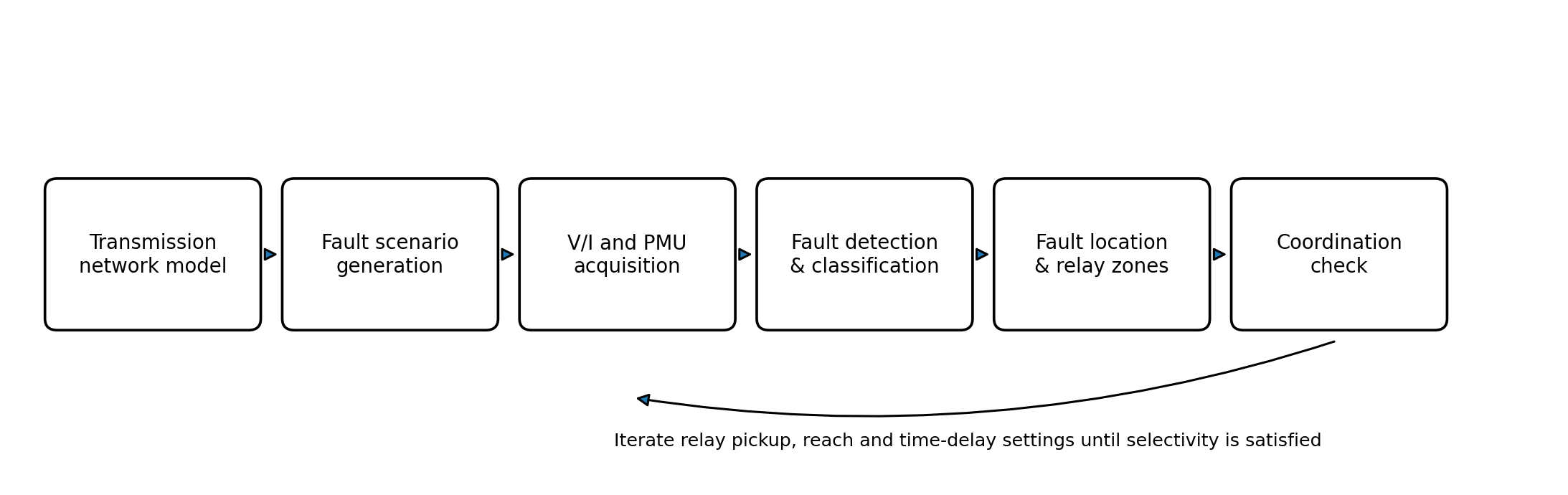
Reliable transmission-line protection requires fault detection, phase classification, fault location and coordinated tripping to operate as a unified process. This methodology paper develops a simulation-oriented framework for studying these functions in high-voltage electrical power transmission networks. The proposed framework combines local current and voltage measurements with synchronized phasor measurement unit (PMU) data, symmetrical-component quantities, apparent-impedance estimation and coordinated distance-relay zones. A structured fault matrix is defined for single-line-to-ground, line-to-line, double-line-to-ground and three-phase faults at multiple locations, inception angles and fault resistances. The detection stage uses current and voltage increments together with sequence quantities; the classification stage identifies involved phases; the location stage combines apparent impedance with synchronized two-end phasor checks; and the coordination stage verifies primary/backup selectivity using distance zones and a wide-area backup criterion. The methodology is evaluated through representative simulation cases using operating time, classification accuracy, location error and coordination margin as performance indicators. The resulting procedure emphasizes fast local action for internal faults while preserving delayed backup operation for adjacent-line faults and preventing unwanted distance-relay operation during power swings. The paper provides a reproducible step-by-step structure suitable for MATLAB/Simulink, PSCAD, EMTP-type environments or commercial power-system protection software. The literature basis is restricted to work published no later than 2016, and every source is identified by DOI.