Intelligent Fault Detection and Protection Coordination in Electrical Power Systems
DOI:
https://doi.org/10.65521/ijaeee.v7i1.4577Keywords:
Abstract
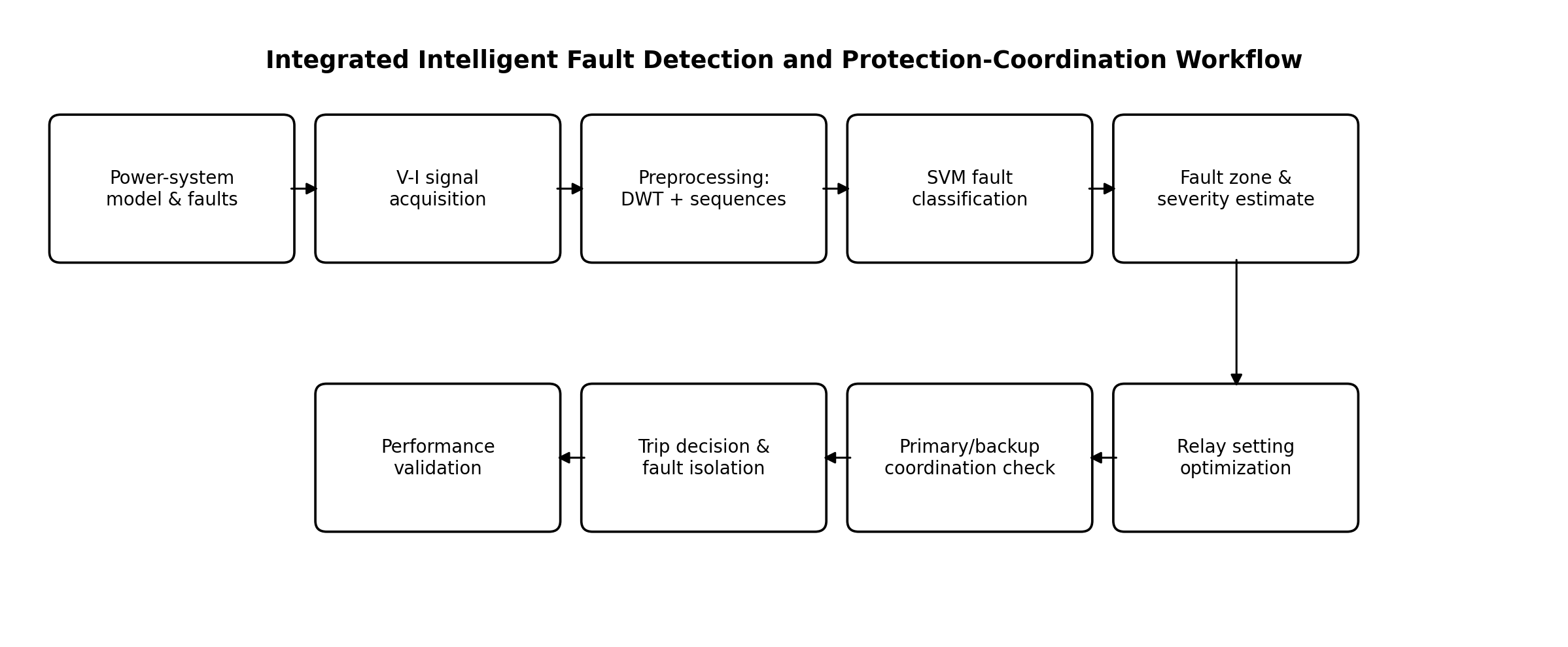
Reliable fault clearance requires two tightly connected functions: rapid identification of the disturbed section and correctly coordinated operation of primary and backup protective devices. This methodology paper develops an integrated framework for intelligent fault detection and relay coordination in electrical power systems using voltage-current measurements, signal processing, support vector machine (SVM) classification, and optimization of directional overcurrent relay settings. A simulation-oriented test procedure is defined for normal operation and line-to-ground, line-to-line, double-line-to-ground, and three-phase faults over multiple fault locations, resistances, inception angles, loading levels, and network configurations. Discrete wavelet transforms and sequence-component features are extracted from short post-fault windows and supplied to an SVM classifier. The detected fault class and estimated zone are then linked to a coordination module that updates pickup current and time-multiplier settings while enforcing a minimum coordination time interval between primary and backup relays. A compact representative dataset generated from the proposed workflow shows classification accuracy above 98%, sub-cycle detection capability, and a reduction in aggregate relay operating time while preserving coordination constraints. The proposed methodology combines the pattern-recognition strengths reported in pre-2019 fault-diagnosis studies with optimization-based protection coordination, creating a practical basis for adaptive and intelligent protection research in conventional and distributed-generation networks.