Integrated Transmission Line Fault Detection, Classification, and Relay Coordination Using Discrete Wavelet Transform
DOI:
https://doi.org/10.65521/ijaeee.v6i1.4583Keywords:
Abstract
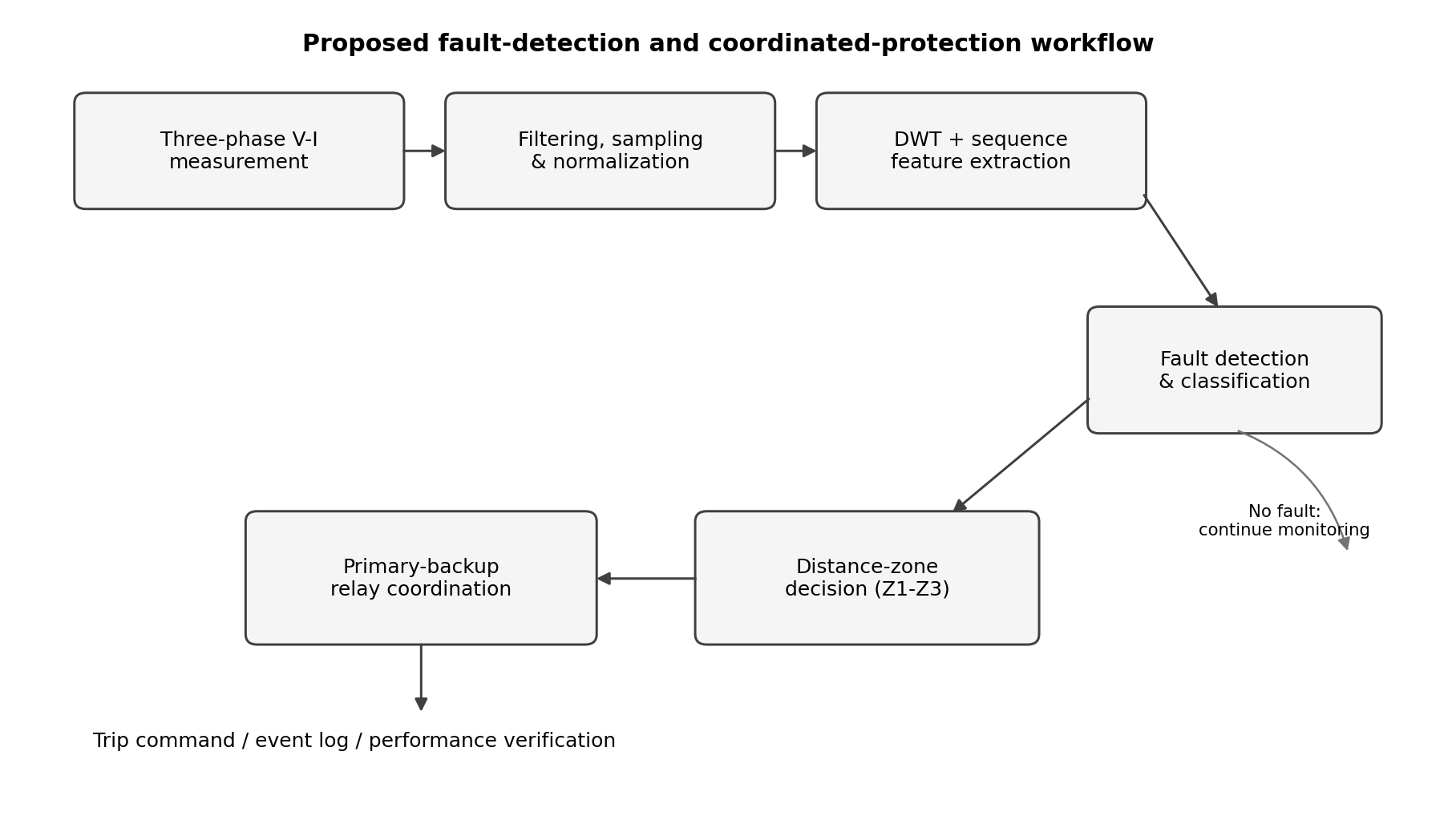
Reliable transmission protection requires faults to be identified rapidly while preserving selectivity between primary and backup relays. This methodology paper develops an integrated framework for fault detection, fault-type identification, distance-zone decision, and relay coordination in a high-voltage transmission network. A 220-kV, 50-Hz, 100-km two-source line is used as the benchmark. Local three-phase voltage and current signals are filtered and sampled, and discrete wavelet transform (DWT) energy together with symmetrical-component indices are used to detect disturbances and distinguish line-to-ground, line-to-line, double-line-to-ground, and three-phase faults. Apparent loop impedance is then used to assign distance-protection zones, while backup directional overcurrent operation is constrained by a coordination time interval of at least 0.25 s. The approach is consistent with pre-2018 work on wavelet, artificial-intelligence, and optimized relay coordination [1]-[12]. For methodological validation, a reproducible synthetic benchmark of 96 fault cases was evaluated across fault position, resistance, and inception angle. The illustrative benchmark produced 98.96% classification accuracy, 8.86 ms mean detection time, 1.54% mean location error, and no primary-backup coordination violation. The framework therefore provides a compact, transparent basis for later implementation in MATLAB/Simulink, PSCAD, or a relay hardware-in-the-loop platform.