Efficient Medical Image Classification Using Masked Attention Networks
DOI:
https://doi.org/10.65521/ijaeee.v6i1.4571Keywords:
Abstract
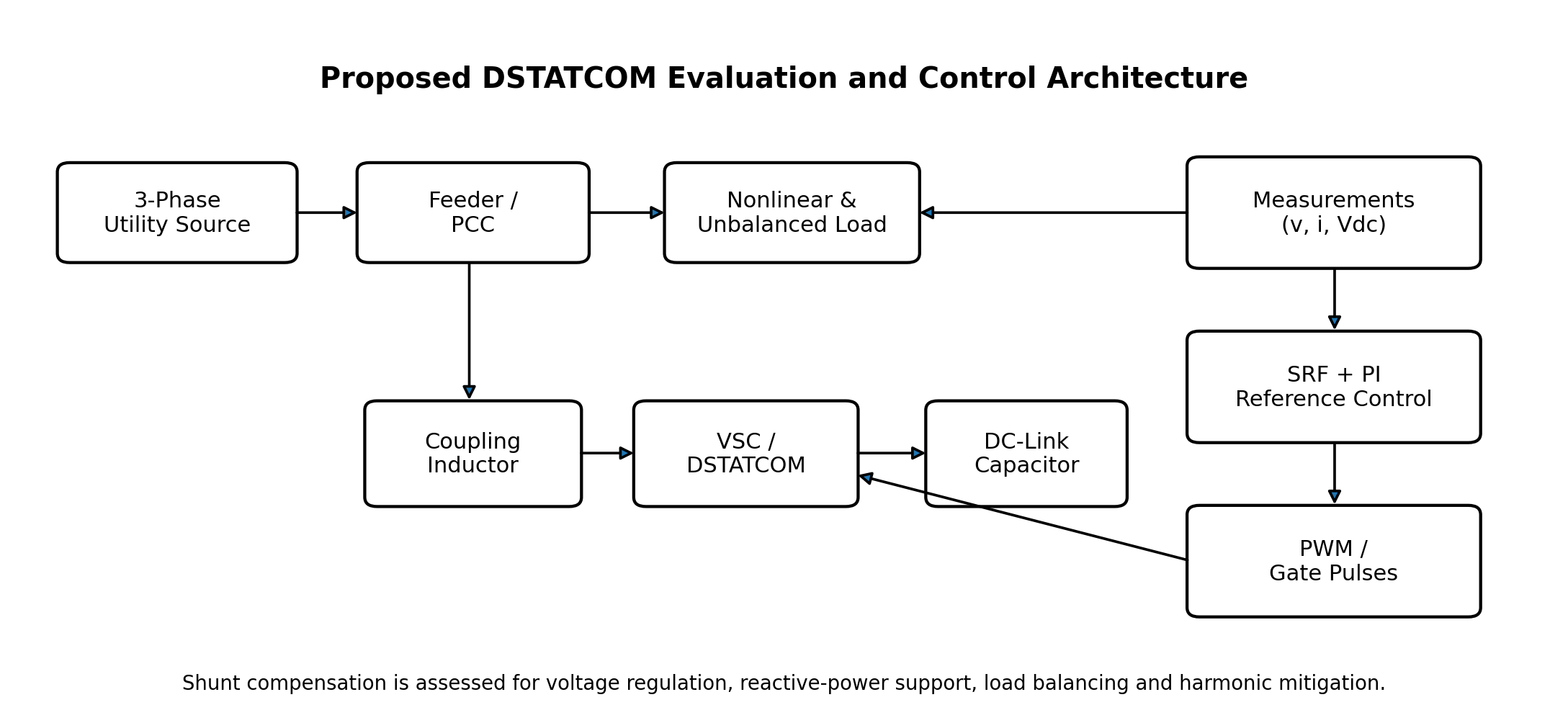
Modern distribution networks are increasingly exposed to nonlinear loads, unbalanced loading, converter-interfaced generation and rapid load changes that produce voltage deviation, poor power factor, current harmonics and neutral-current stress. This paper develops a structured methodology for evaluating a distribution static compensator (DSTATCOM) as a shunt-connected power-quality conditioner at the point of common coupling. The proposed study uses a voltage-source converter, DC-link capacitor, coupling inductor, synchronous-reference-frame current extraction and proportional-integral regulation. The evaluation is organized around four operating conditions: balanced lagging load, unbalanced load, nonlinear rectifier load, and short-duration voltage sag/swell. Performance is quantified through PCC voltage, source-current total harmonic distortion, source power factor, voltage unbalance, reactive-power demand and settling time. The methodology also includes device sizing, DC-link selection, controller tuning, simulation sequencing and comparative testing with and without compensation. A representative benchmark dataset shows that properly controlled DSTATCOM operation can restore the PCC voltage close to nominal, substantially reduce harmonic current, improve source power factor toward unity and transfer most reactive-power demand from the source to the compensator. The framework is intended as a reproducible basis for MATLAB/Simulink or laboratory validation of DSTATCOM-based power-quality improvement.