Energy-Efficient Multilevel Inverter Topologies for Renewable Energy Applications
DOI:
https://doi.org/10.65521/ijaeee.v4i1.4566Keywords:
Abstract
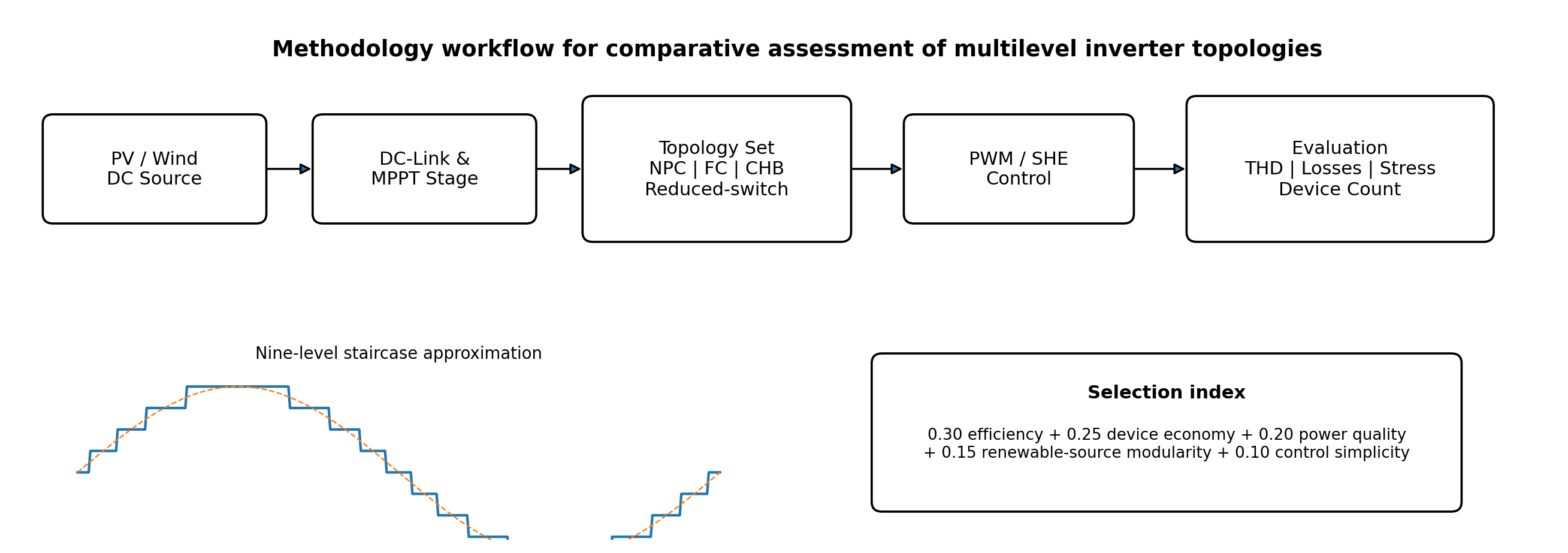
Multilevel inverters (MLIs) are attractive interfaces for photovoltaic, wind, fuel-cell, and energy-storage systems because they synthesize a near-sinusoidal AC waveform from multiple DC voltage levels while reducing device voltage stress and filtering demand. This methodology paper develops a reproducible framework for selecting an energy-efficient MLI topology using literature available up to 2015. The framework compares neutral-point-clamped (NPC), flying-capacitor (FC), cascaded H-bridge (CHB), and reduced-switch cascaded structures on semiconductor count, auxiliary components, DC-source requirements, switching/conduction loss tendency, harmonic quality, voltage stress, control burden, and renewable-source compatibility. A common 9-level, single-phase design basis is used for analytical comparison, while a normalized selection index prevents any one metric from dominating the decision. The study shows why CHB structures are naturally suited to modular renewable DC sources, whereas reduced-switch cascaded topologies can further improve device economy and lower gate-drive and switching-loss burden. The proposed method is intended as a practical pre-simulation screening procedure before detailed MATLAB/Simulink or hardware validation.