Processing, Characterization, and Performance Evaluation of Epoxy–Graphene Nanocomposites for Engineering Applications
DOI:
https://doi.org/10.65521/ijaeee.v9i1.4618Keywords:
Abstract
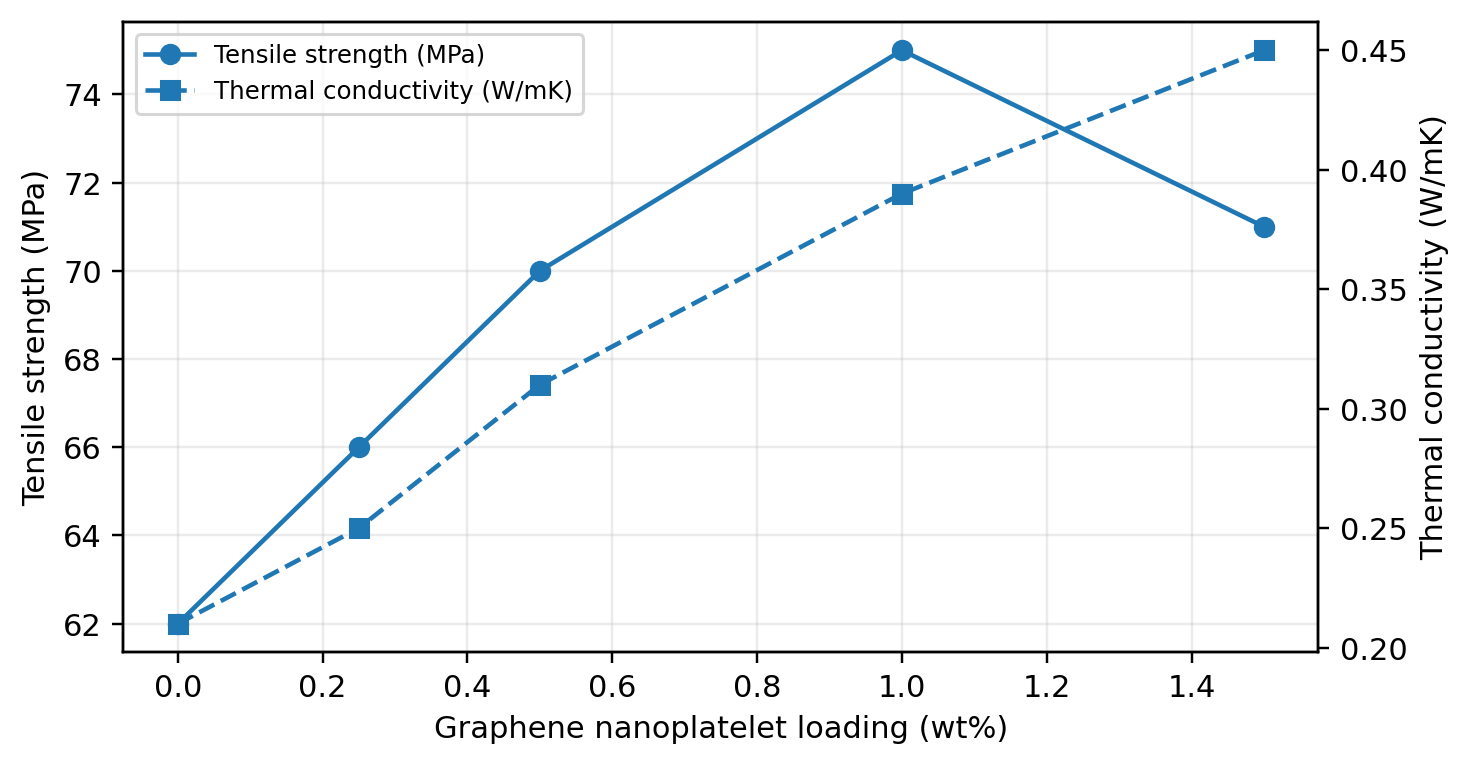
Polymer nanocomposites combine a continuous polymer matrix with nanoscale fillers to obtain property improvements that are difficult to achieve with conventional microfilled systems. This methodology paper presents a reproducible laboratory framework for preparing and characterizing polymer nanocomposites intended for industrial structural, coating, packaging, electronic, and thermal-management applications. An epoxy/graphene nanoplatelet (GNP) system is selected as the representative formulation because thermoset epoxies are widely used in engineering components, whereas graphene-based fillers can enhance stiffness, thermal transport, barrier behavior, and electrical response at relatively low loading. The proposed workflow includes nanofiller drying and optional surface treatment, solvent-assisted ultrasonication, high-shear mixing, vacuum degassing, controlled curing, specimen preparation, and multi-technique characterization. Fourier-transform infrared spectroscopy (FTIR), X-ray diffraction (XRD), scanning electron microscopy (SEM), thermogravimetric analysis (TGA), differential scanning calorimetry (DSC), tensile testing, thermal-conductivity measurement, and electrical-resistivity testing are integrated to relate processing, dispersion, interface quality, and final performance. A design with 0-1.5 wt% GNP is used to demonstrate optimization and statistical comparison. The representative results show the expected trade-off between reinforcement and agglomeration: mechanical properties improve up to an intermediate loading, while thermal transport continues to increase with filler fraction. The methodology therefore emphasizes dispersion quality and interfacial adhesion, rather than filler loading alone, as the central variables controlling industrial performance. The framework can be adapted to nanoclay, carbon nanotube, silica, metal-oxide, cellulose, and hybrid nanofiller systems.