Fabrication and Evaluation of Functionalized Multi-Walled Carbon Nanotubes for Heavy Metal Removal from Aqueous Solutions
DOI:
https://doi.org/10.65521/ijaeee.v10i1.4611Keywords:
Abstract
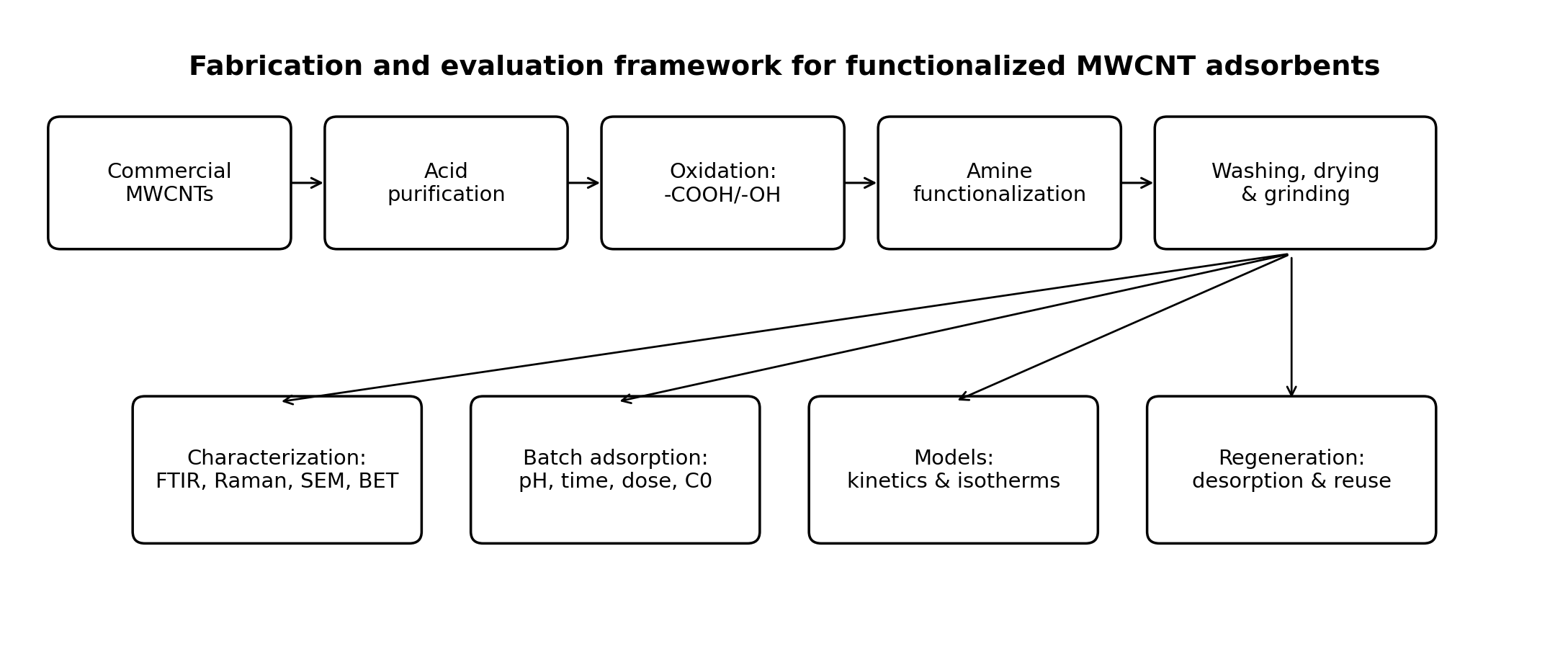
Functionalized carbon nanotubes (CNTs) are high-surface-area adsorbents whose metal-binding performance can be improved by introducing oxygen- and nitrogen-containing surface groups. This methodology paper proposes a reproducible fabrication and evaluation framework for multi-walled carbon nanotubes (MWCNTs) intended for removal of Pb(II), Cd(II), and Cu(II) from aqueous solutions. Commercial MWCNTs are first purified and oxidized with nitric acid to generate carboxyl and hydroxyl groups, followed by amine functionalization to increase chelation sites and aqueous dispersibility. Pristine, oxidized, and amine-functionalized MWCNTs are compared using Fourier-transform infrared spectroscopy (FTIR), Raman spectroscopy, scanning electron microscopy (SEM), Brunauer-Emmett-Teller (BET) surface analysis, and zeta-potential measurements. Batch adsorption experiments evaluate the effects of solution pH, contact time, adsorbent dose, initial metal concentration, and competing ions. Adsorption capacity and removal efficiency are calculated and interpreted with pseudo-first-order, pseudo-second-order, Langmuir, and Freundlich models. Regeneration is evaluated through acid desorption and repeated adsorption-desorption cycles. Literature-calibrated illustrative data predict a progressive increase in metal removal from pristine MWCNTs to oxidized MWCNTs and NH2-MWCNTs, with Pb(II) showing the strongest adsorption under optimized conditions. The method emphasizes adsorption performance, dispersion stability, reuse, and leaching control, providing a practical protocol for laboratory development of CNT-based heavy-metal sorbents.