Corrosion Inhibition Performance of Tannic Acid, Gallic Acid, Quercetin, and Ascorbic Acid on Mild Steel
DOI:
https://doi.org/10.65521/ijaeee.v9i1.4616Keywords:
Abstract
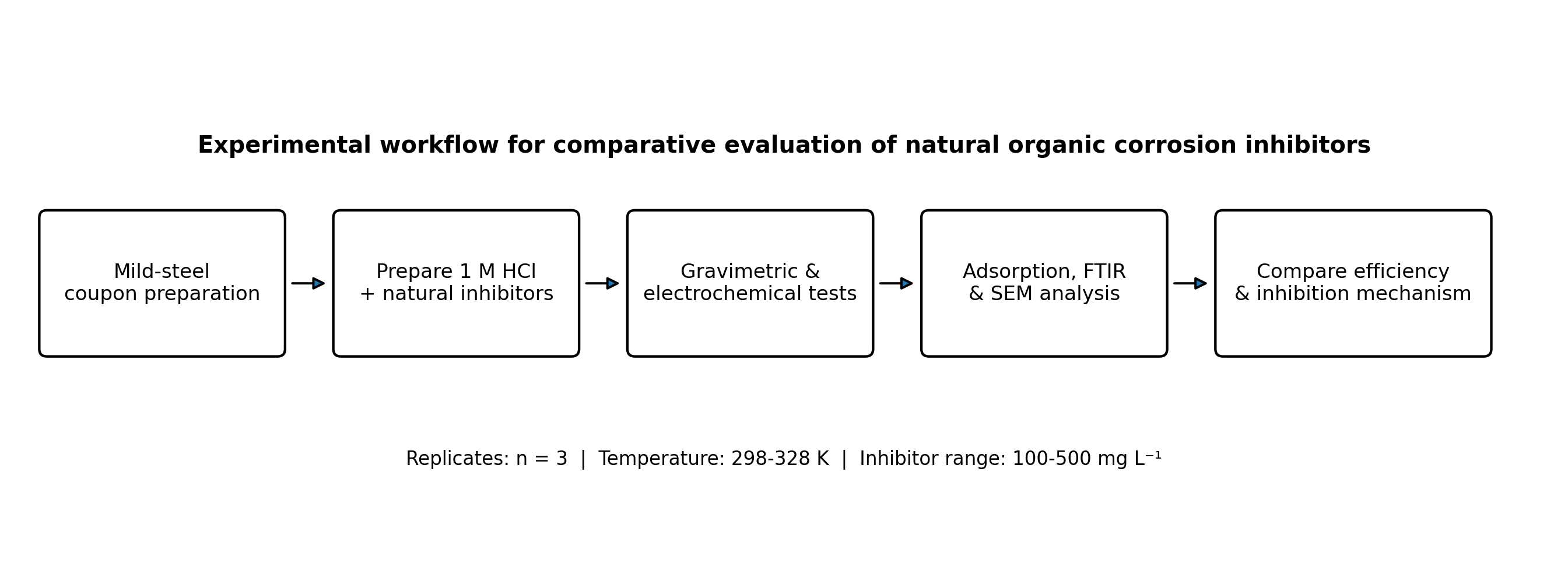
Corrosion of mild steel in acidic media is a persistent problem in pickling, cleaning, oil-and-gas, chemical-processing and maintenance operations. The environmental and toxicological limitations of many conventional inhibitors have encouraged the evaluation of naturally occurring organic molecules as sustainable surface-protective agents. This methodology paper presents a comparative framework for evaluating tannic acid, gallic acid, quercetin and L-ascorbic acid as model natural organic corrosion inhibitors for mild steel in 1 M hydrochloric acid. The protocol integrates gravimetric weight-loss measurements, potentiodynamic polarization, electrochemical impedance spectroscopy (EIS), adsorption-isotherm analysis, Fourier-transform infrared spectroscopy (FTIR) and scanning electron microscopy (SEM). Inhibitor concentrations of 100-500 mg L−1 and temperatures of 298-328 K are proposed, with triplicate measurements and matched solvent controls. Corrosion rate, inhibition efficiency, charge-transfer resistance, double-layer capacitance and corrosion-current density are used as primary response variables. A transparent illustrative dataset demonstrates the statistical and mechanistic interpretation expected from the framework: increasing inhibitor concentration should reduce mass loss and corrosion-current density, increase charge-transfer resistance and promote surface-film formation. Tannic acid and quercetin are expected to show strong adsorption because of multiple aromatic rings and oxygen-containing donor sites, whereas gallic and ascorbic acids provide smaller but highly polar adsorption structures. The methodology provides a reproducible basis for screening natural organic compounds before scale-up to industrial corrosion-control applications.