Comparative Evaluation of Green Solvents for Sustainable Organic Synthesis Processes
DOI:
https://doi.org/10.65521/ijaeee.v10i1.4615Keywords:
Abstract
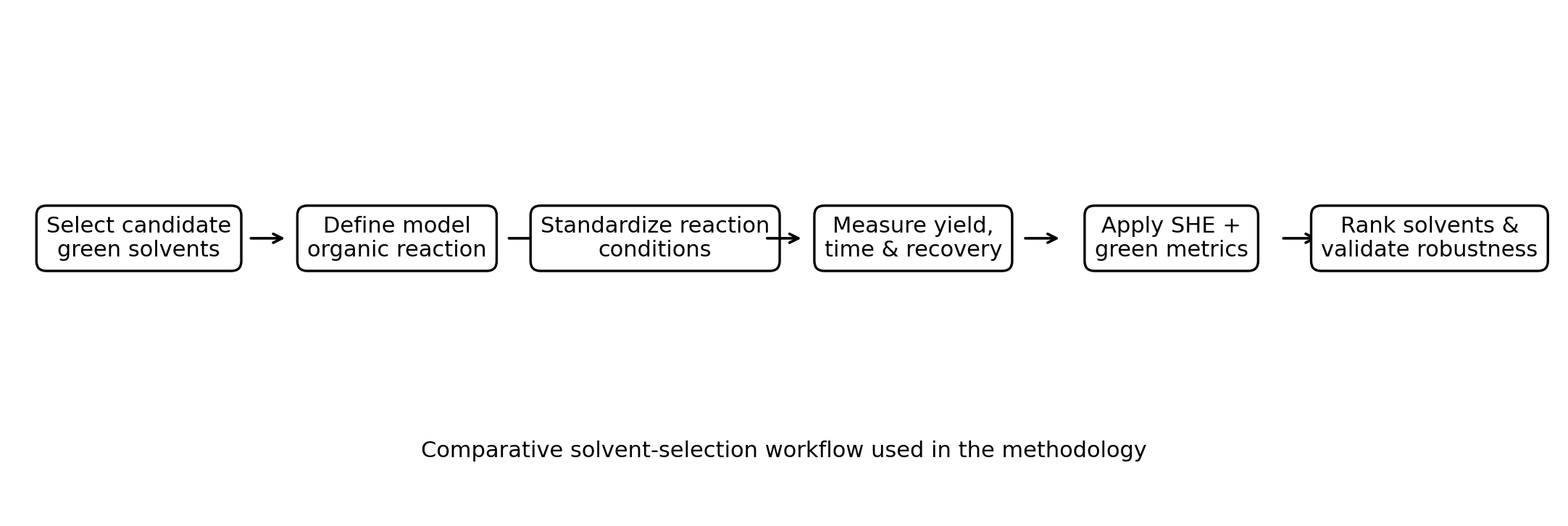
Solvents frequently constitute the largest material fraction of an organic synthesis process and strongly influence worker safety, emissions, energy demand, waste generation, reaction rate and downstream separation. This methodology paper develops a comparative framework for selecting green solvents for sustainable organic synthesis. Six representative media—water, ethanol, 2-methyltetrahydrofuran (2-MeTHF), γ-valerolactone (GVL), glycerol and a choline-chloride-based deep eutectic solvent (DES)—are assessed through a combined experimental and multi-criteria protocol. The proposed workflow uses a standardized Knoevenagel condensation as a model transformation and evaluates reaction yield, reaction time, solvent recovery, energy requirement, safety-health-environment (SHE) profile, renewability and waste-related indicators. A weighted sustainability index is then applied to compare solvent performance without treating any single property as sufficient to define ‘greenness’. Literature available through 2021 shows that water and bio-derived solvents can markedly reduce hazard and life-cycle burden, while emerging solvents such as GVL and DES can provide useful polarity and low volatility but may impose recovery or viscosity penalties. The methodology therefore emphasizes fit-for-purpose solvent selection rather than a universal ranking. Illustrative benchmark results demonstrate how the framework can identify balanced solvent choices for laboratory and process-scale organic synthesis while preserving transparency between measured data and sustainability scoring.