A Dual-Battery Electric Bicycle with Relay-Based Pack Selection
Keywords:
Abstract
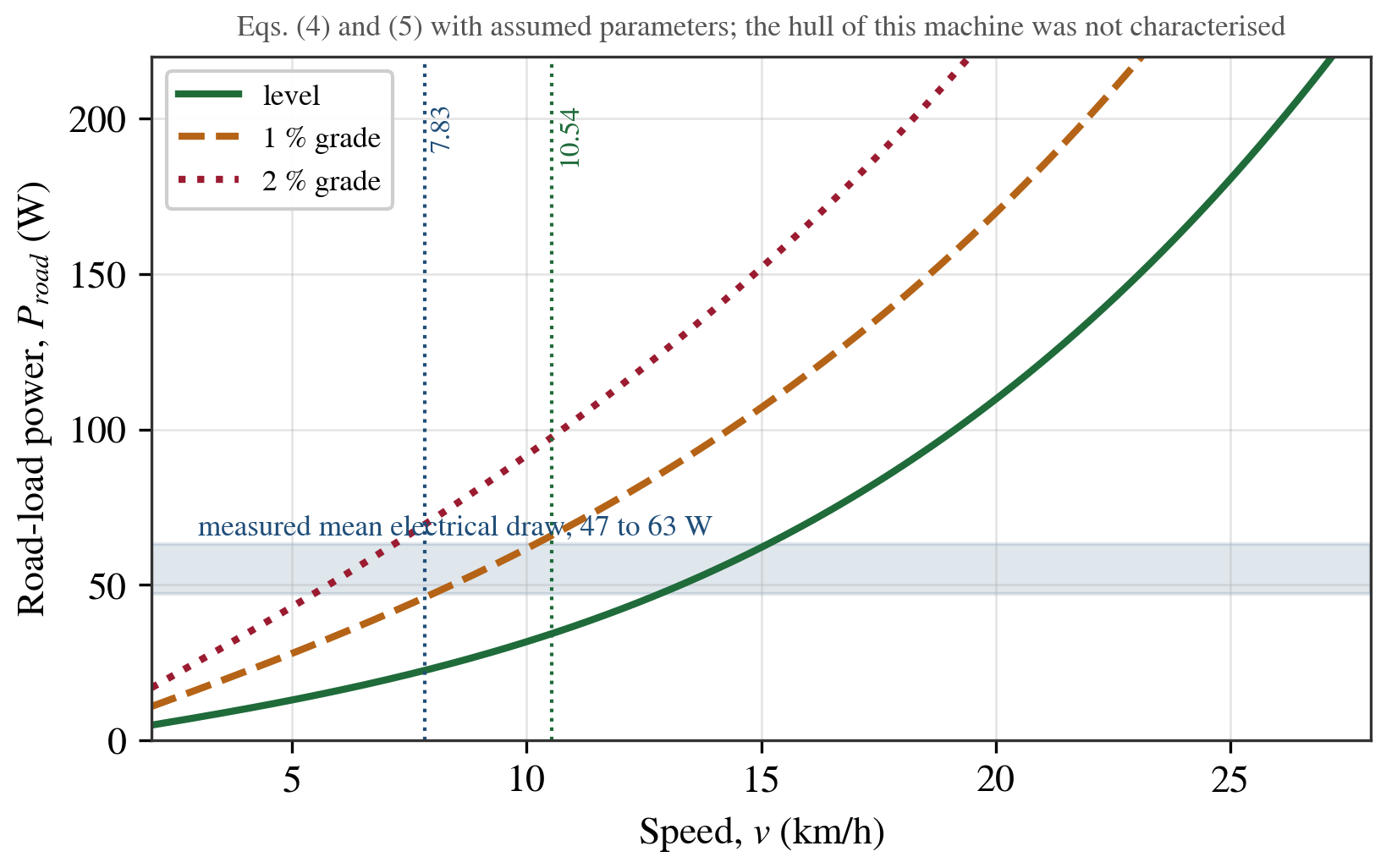
This paper reports a road trial of a permanent-magnet DC electric bicycle carrying two 24 V battery packs selected by relay, together with voltage and current sensing, a light-dependent resistor input and a local display. The recorded trial data are reported in full: 47.04 km covered, 267.86 min total time, 26 km/h maximum speed, 7.83 km/h stated average speed, 0 to 20 km/h in about 6 s, a 3 s stop with both brakes applied, and a mean consumption of 6 Wh/km. These values are then audited arithmetically rather than repeated, and the audit is the paper's central result. The stated average speed is inconsistent with the recorded distance and time, which imply 10.54 km/h; covering 47.04 km at 7.83 km/h would require 360.5 min, or 92.6 min more than the trial recorded. The discrepancy is reported openly, the most plausible reconciliation, that the recorded time is moving time while the stated average includes stops, is identified as a hypothesis, and no single figure is silently adopted. Consumption is cross-checked and found self-consistent: 6 Wh/km over 47.04 km implies 282.2 Wh, or 11.76 Ah at 24 V, which matches a conventional 12 Ah pack closely. This revision, however, notes that the agreement may be circular: a 12 Ah pack at 24 V discharged over exactly this distance yields 6.12 Wh/km, so if the consumption figure was obtained by dividing nameplate capacity by distance rather than measured independently, the cross-check passes by construction. The record does not say which, and the paper says so. The same consumption figure implies a mean electrical power of 47 to 63 W, which this revision compares against a computed road load of 22 to 34 W on level ground and 46 to 66 W on a one per cent gradient, bracketing the measurement and showing that drivetrain loss and route gradient cannot be separated from the trip-level record. Braking and acceleration are converted to decelerations and distances with their conditioning assumptions stated. Two capabilities named in the design, regenerative braking and automatic pack swapping, produced no measurement and are reported as unverified.