FPGA-Based Intelligent Traffic Monitoring and Signal Control System for Smart Cities
DOI:
https://doi.org/10.65521/ijaeee.v13i2.4581Keywords:
Abstract
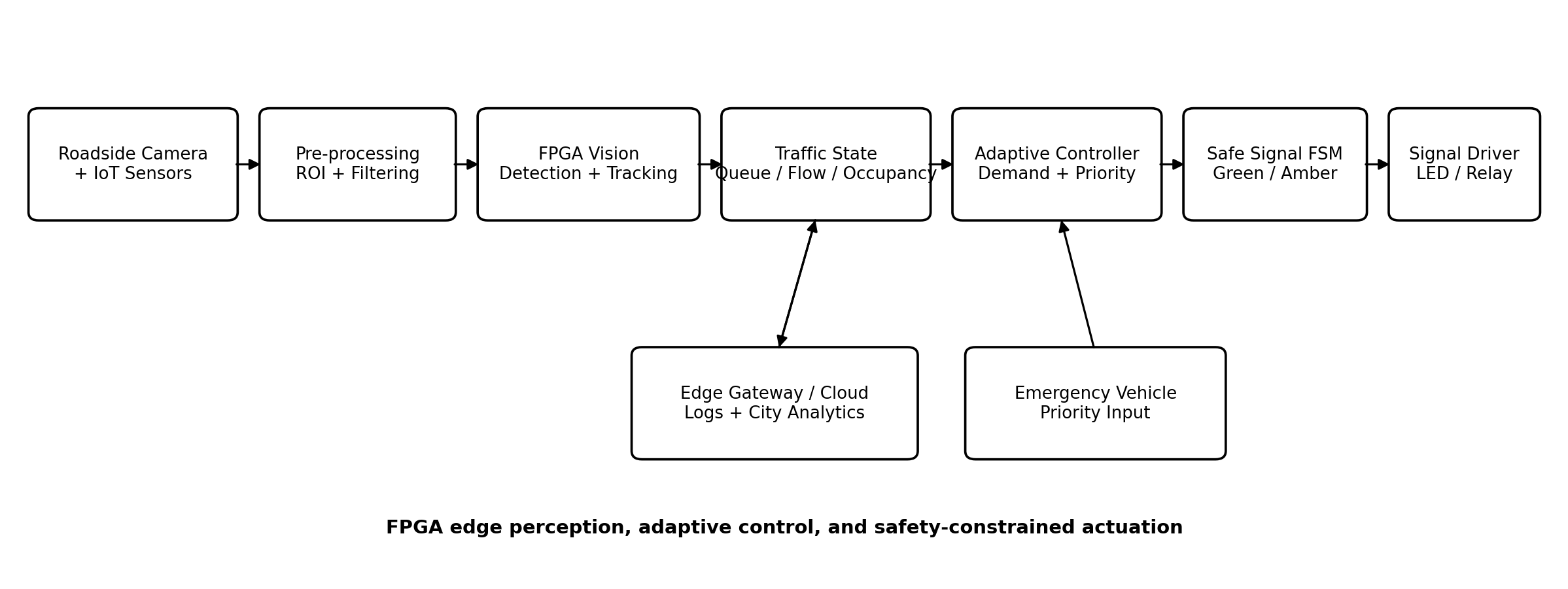
Urban traffic congestion requires monitoring and signal control that can react within seconds while remaining energy-efficient, deterministic, and deployable near the intersection. This methodology paper reviews field-programmable gate array (FPGA) approaches for traffic video processing and combines them with contemporary adaptive traffic-signal concepts to formulate a practical smart-city architecture. The proposed method places image acquisition, filtering, vehicle detection, tracking, queue estimation, and traffic-state extraction in a deeply pipelined FPGA datapath, while a lightweight adaptive controller allocates green time according to normalized queue length, flow, occupancy, and emergency priority. A fail-safe finite-state machine enforces minimum green, amber, and all-red clearance constraints. The framework also supports an edge gateway for logging, model updates, and city-level analytics without continuously transmitting raw video. A reproducible four-approach traffic simulation is used to illustrate the evaluation procedure. Across 30 seeded runs of a 2400 s scenario, the adaptive policy reduced mean waiting time from 20.97 s to 12.46 s and mean total queue from 13.19 to 7.85 vehicles relative to a fixed-time baseline. These values are simulation outputs under stated assumptions, not field measurements. The reviewed literature and proposed methodology indicate that FPGA acceleration is particularly suitable where low latency, predictable timing, and energy-aware edge processing are more important than unrestricted software flexibility