An IoT Gas, Flame and Environment Monitoring Node for Explosion-Risk Detection
Keywords:
Abstract
This paper reports an IoT monitoring node built to demonstrate early detection of explosion-risk conditions, and assesses it against the requirements that apply to gas detection in flammable atmospheres. The node combines a metal-oxide combustible-gas sensor, a flame sensor read as an analogue range, a temperature and humidity sensor, an ESP8266 controller, a relay-driven ventilation actuator and a cloud dashboard. The telemetry actually recorded is reported exactly as captured: a single snapshot showing 32 degrees Celsius, 82 % relative humidity and a gas channel reading zero, together with a demonstrated fire-detected notification. The assessment then states plainly what such a record can support. Because the gas channel was never exposed to certified calibration gas, its output remains an uncalibrated ratiometric value, not a concentration. Therefore, no LEL or ppm reading or alarm threshold is justified; zero only indicates no response, not gas absence.
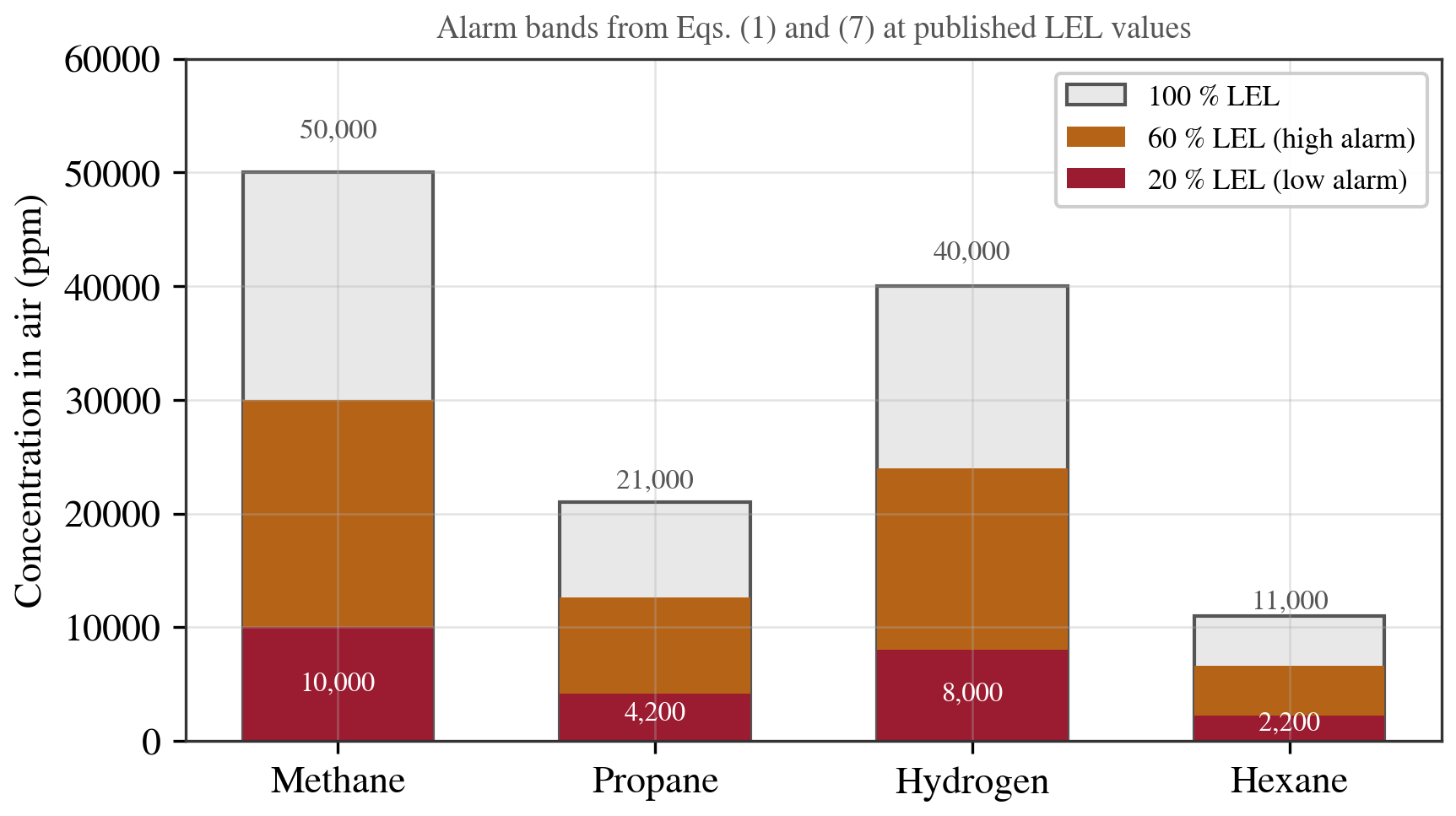
Detection time, minimum detectable concentration, cross-sensitivity, warm-up behaviour and drift were likewise not measured. Metal-oxide sensor response is further shown from the literature to depend strongly on humidity, which the recorded 82 % places in the region where that dependence is largest. This revision adds two quantitative elements. First, the alarm bands the paper discusses are expressed in absolute units using published explosive limits, so that the concentration range an instrument would have to span is stated rather than left abstract: a low alarm at 20 % of the limit corresponds to 10,000 ppm for methane and 4,200 ppm for propane. Second, the ventilation relations are evaluated, showing that a relay-driven fan dilutes an enclosure on a timescale of tens of minutes, which places it firmly among slow mitigations rather than protective responses. The paper separates built-and-demonstrated capability from unmeasured capability, and states the certification and enclosure requirements that a node intended for a genuinely hazardous area must satisfy but which this prototype does not address.