
Implementation of IoT-Based Home Automation System Using Embedded Microcontrollers
Keywords:
Abstract
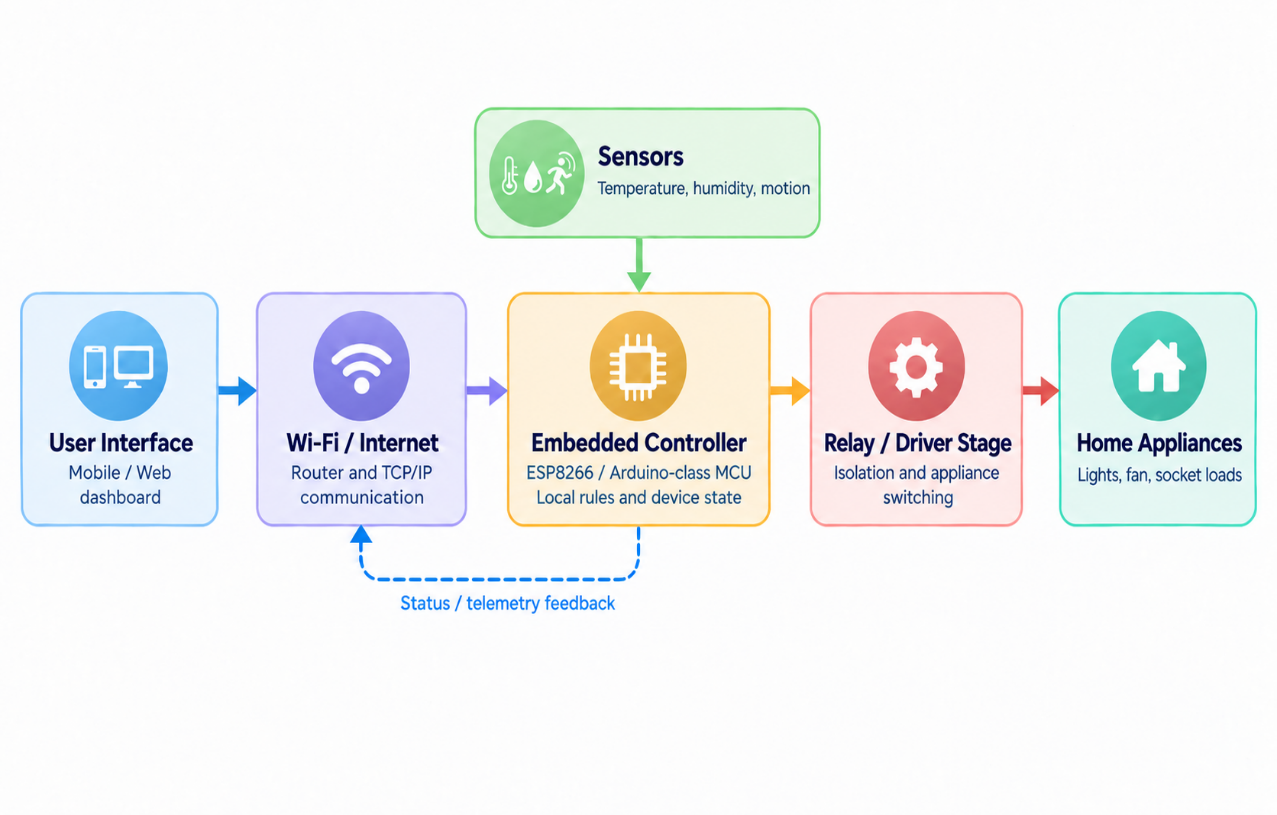
The Internet of Things (IoT) enables ordinary electrical devices to be connected, monitored, and controlled through networked embedded systems. This methodology paper presents a low-cost architecture for implementing a home automation system using embedded microcontrollers, Wi-Fi communication, environmental sensors, and relay-driven household loads. The proposed design uses an ESP8266/Arduino-class controller as the local control node, a wireless router as the access gateway, and a browser- or smartphone-based interface for remote operation. Temperature, humidity, and motion sensing are included to demonstrate both monitoring and rule-based control. The methodology defines hardware selection, circuit integration, firmware development, communication logic, user-interface interaction, security controls, and an acceptance-test procedure. Earlier work established the feasibility of Bluetooth, ZigBee, web-based, and sensor-network home automation; the present methodology integrates these ideas into an Internet-addressable embedded platform appropriate to the technology available by 2016. The evaluation framework measures command success rate, end-to-end latency, sensor accuracy, network recovery, and power consumption. A representative validation scenario indicates that the architecture can provide responsive control with modest hardware complexity while retaining scalability for additional rooms and devices. The method is intended as a reproducible basis for prototype development and academic evaluation rather than as a claim of a completed commercial product.
Downloads
Downloads
Published
How to Cite
Issue
Section
License

This work is licensed under a Creative Commons Attribution-NoDerivatives 4.0 International License.
