
Development of a Smart Traffic Management System Using Embedded and IoT Technologies
Keywords:
Abstract
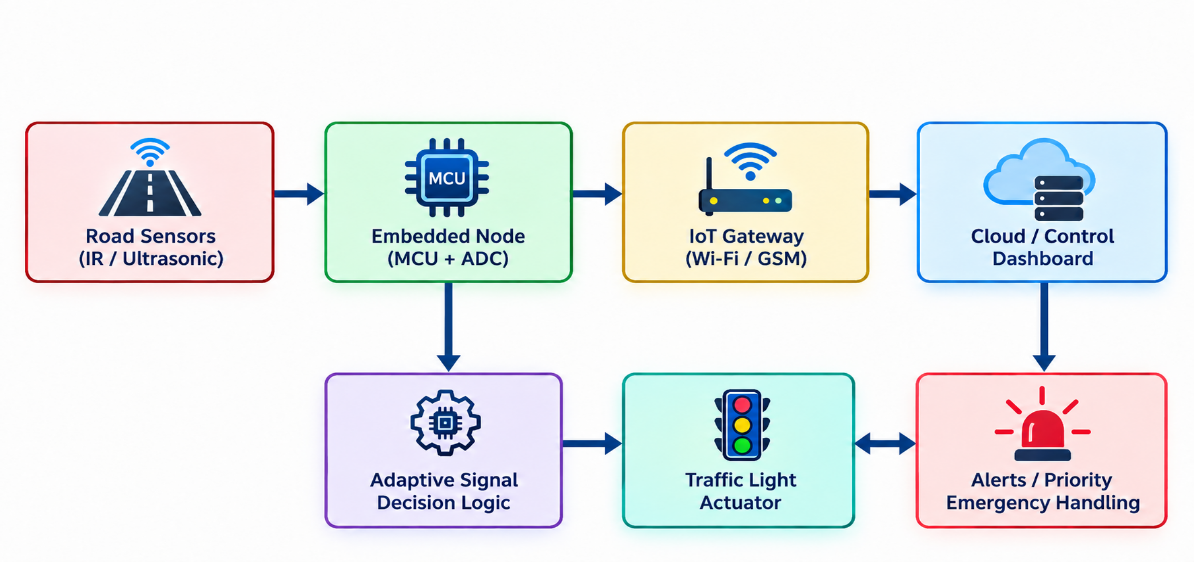
Urban intersections increasingly require traffic-control mechanisms that can react to changing vehicle demand rather than relying only on predetermined signal timing. This methodology paper presents the development and evaluation framework for a smart traffic management system that combines embedded sensing, microcontroller-based local control, Internet of Things (IoT) communication, and adaptive signal timing. The proposed design uses roadside infrared or ultrasonic sensing to estimate lane occupancy and queue demand, an embedded controller to preprocess measurements, an IoT gateway to exchange status information, and a decision module to vary green time, provide emergency priority, and publish traffic data to a supervisory dashboard. The study follows a design-and-evaluate methodology: system requirements are derived from pre-2017 IoT and intelligent-transport literature, a layered architecture is specified, the adaptive control logic is implemented as a queue-responsive algorithm, and performance is evaluated against a conventional fixed-time signal under controlled low, medium, and high traffic demand. Across the modeled scenarios, the adaptive approach reduced average delay from 17.58 to 6.56 s under low demand, from 25.76 to 9.99 s under medium demand, and from 102.71 to 26.72 s under high demand. These findings indicate that combining embedded intelligence with connected sensing can improve traffic responsiveness while retaining a low-cost, modular architecture suitable for future field deployment. The reported results are controlled prototype/simulation outcomes and should be validated through real-road experiments before operational adoption.
Downloads
Downloads
Published
How to Cite
Issue
Section
License

This work is licensed under a Creative Commons Attribution-NoDerivatives 4.0 International License.
