
Adaptive Intersection Control Using Embedded Traffic Sensing and IoT-Based Monitoring
DOI:
https://doi.org/10.65521/intjournalrecadvengtech.v6i1.4433Keywords:
Abstract
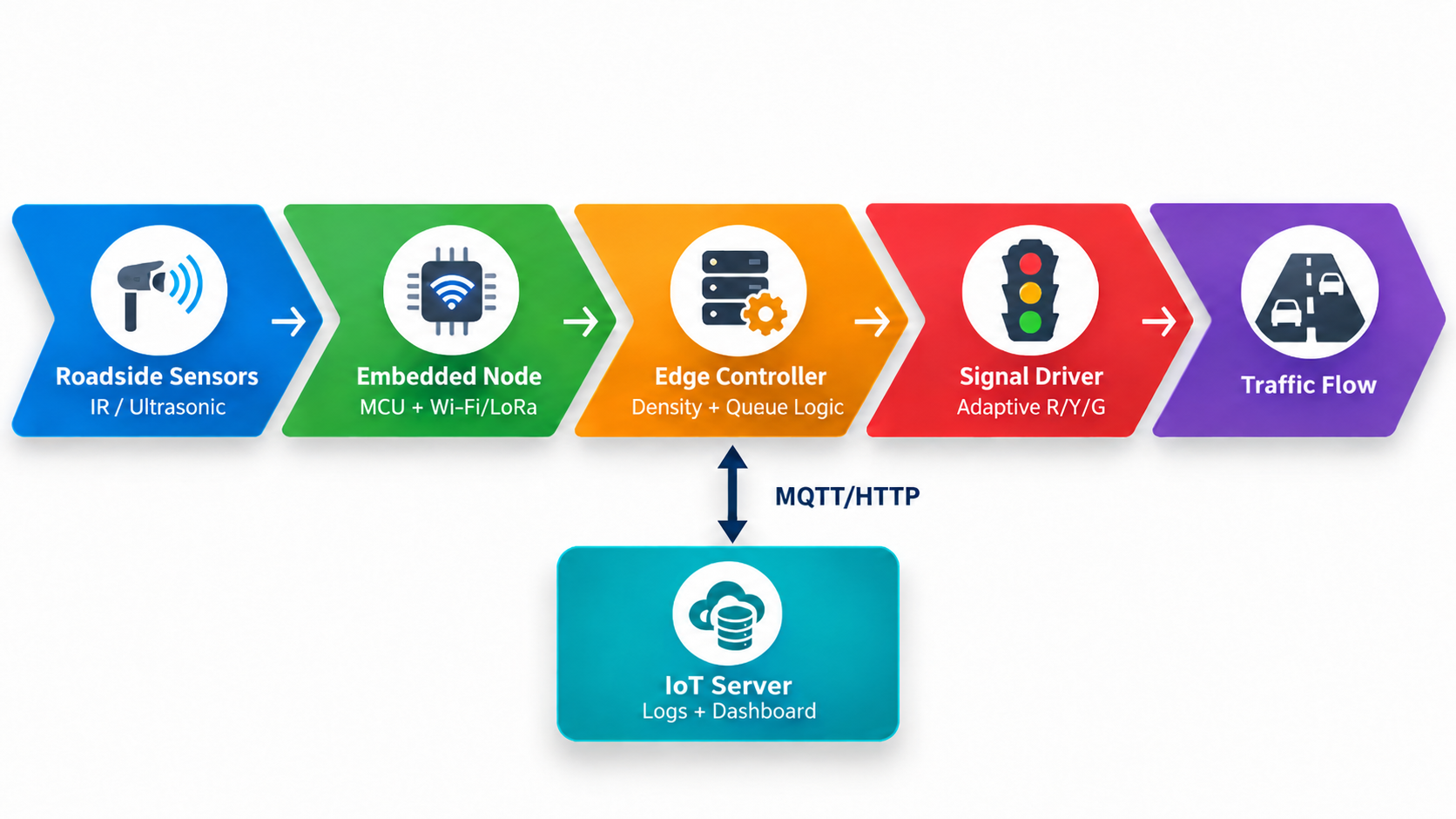
Traffic congestion at urban intersections is often aggravated by fixed-time signal control that cannot respond effectively to short-term variations in traffic demand. This study presents an adaptive intersection-control framework that integrates roadside vehicle sensing, embedded processing, network-based monitoring, and locally executed signal-timing decisions. Each incoming approach is monitored using infrared or ultrasonic detectors connected to a microcontroller-class embedded node. The acquired sensor data are filtered and converted into traffic descriptors representing lane density, queue severity, and accumulated waiting demand. These parameters are used by a local edge controller to calculate phase priorities and dynamically allocate green time within predefined minimum and maximum safety limits. Lightweight IoT communication through Wi-Fi, MQTT/HTTP, or low-power wide-area connectivity is incorporated for telemetry, logging, visualization, and parameter management, while safety-critical signal operation remains under local embedded control. The methodology includes sensor acquisition, preprocessing, traffic-priority computation, adaptive green-time calculation, signal actuation, fail-safe operation, and controlled prototype evaluation. Performance is assessed at a four-arm intersection under low, medium, and high traffic-demand conditions by comparing the adaptive controller with a conventional fixed-time strategy. The results show that average waiting time decreases from 22.8 to 17.3 seconds under low demand, from 48.5 to 32.4 seconds under medium demand, and from 83.2 to 50.9 seconds under high demand. Maximum queue length is also reduced, while the adaptive controller maintains effective vehicle discharge under increasing traffic intensity. The findings demonstrate that local embedded traffic sensing combined with adaptive signal timing and network-based monitoring can provide a practical and responsive approach to intersection management while maintaining fail-safe operation during communication or sensor disturbances.
Downloads
Downloads
Published
How to Cite
Issue
Section
License

This work is licensed under a Creative Commons Attribution-NoDerivatives 4.0 International License.
