
Development Of An Automated Traffic Management System Using Image Processing Techniques
Keywords:
Abstract
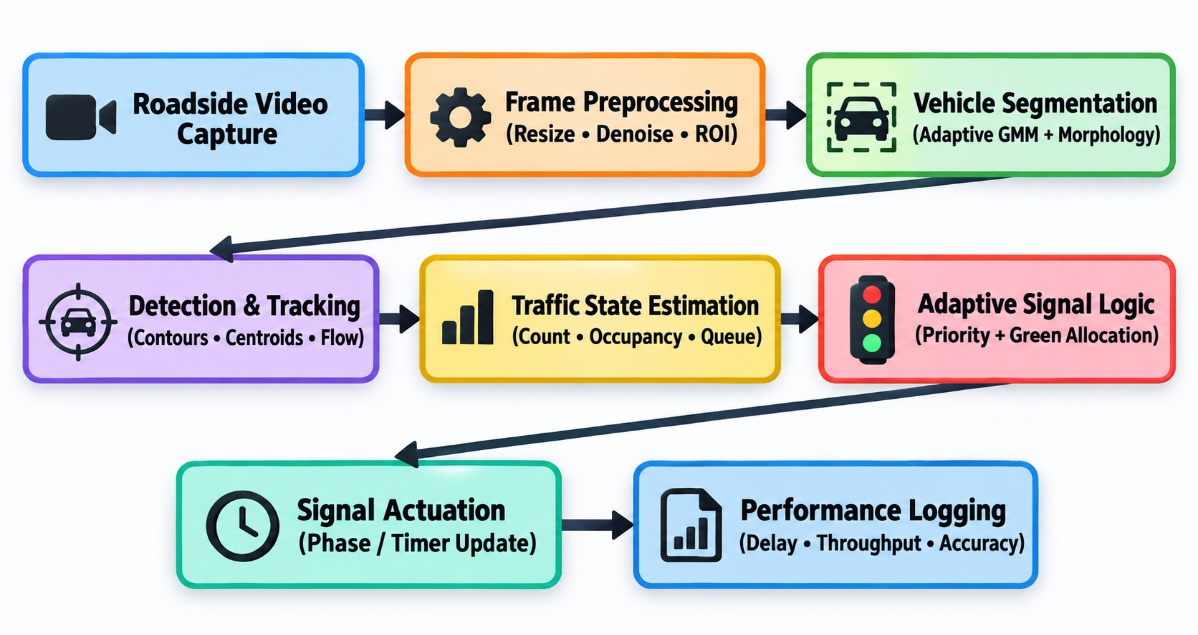
Urban intersections frequently suffer from unnecessary delay because conventional fixed-time controllers allocate green time according to predetermined schedules rather than the traffic that is actually present. This methodology paper develops an automated traffic management framework in which roadside video is processed to estimate lane-wise vehicle demand and to adjust signal timing dynamically. The proposed approach uses region-of-interest masking, adaptive background subtraction, morphological filtering, connected-component analysis, centroid-based tracking and traffic-density estimation. Classical image-processing methods are selected as the primary implementation because they are computationally economical, transparent and suitable for deployment on modest roadside hardware; established real-time object detectors are treated as optional validation or upgrade modules. The controller converts measured queue occupancy and vehicle counts into bounded green-time allocations while preserving minimum green, amber and safety-clearance intervals. A prototype evaluation protocol is defined for daylight, shadow, moderate congestion and highly imbalanced approaches. For demonstration, an illustrative simulation based on the defined protocol indicates an overall detection precision of 93.3%, recall of 91.8% and F1-score of 92.5%, together with a reduction in mean waiting time relative to a fixed-time baseline. These values are reported as methodology demonstration outputs rather than claimed field observations. The framework shows how computer vision can connect traffic sensing directly with adaptive signal control and provides a reproducible basis for later roadside validation.
Downloads
Downloads
Published
How to Cite
Issue
Section
License

This work is licensed under a Creative Commons Attribution-NoDerivatives 4.0 International License.
