
Implementation of FPGA-Based Real-Time Image Processing for Automated Inspection Applications
Keywords:
Abstract
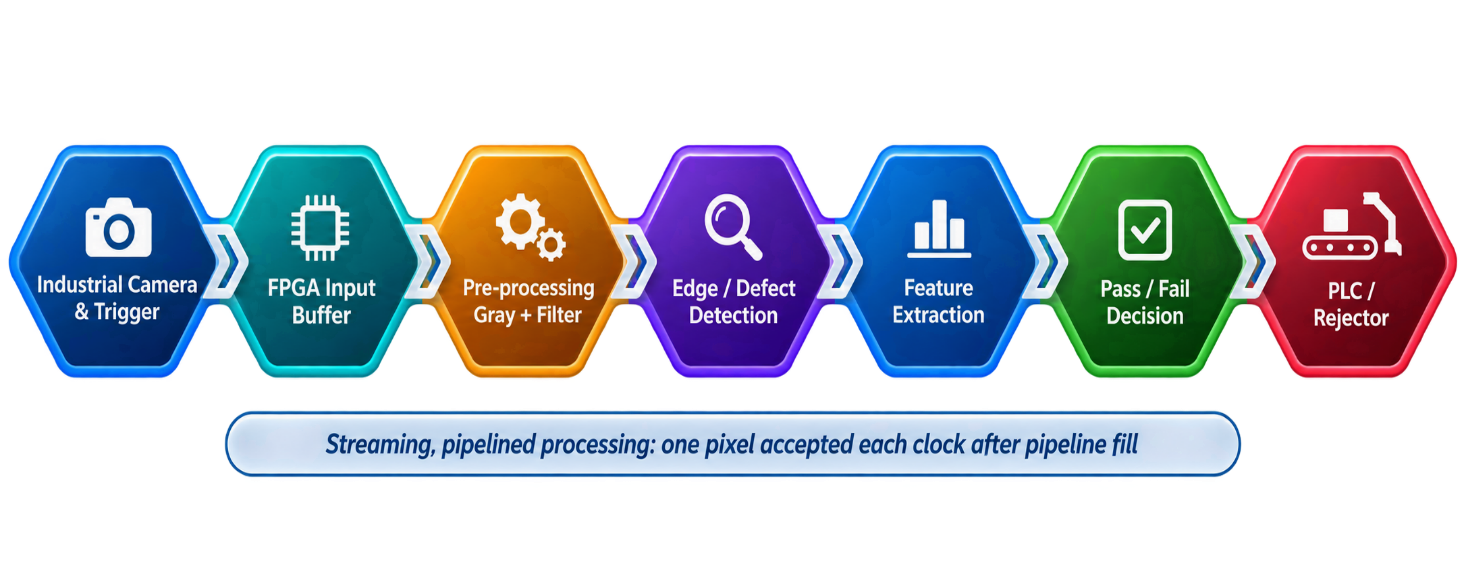
Automated visual inspection requires deterministic image acquisition, low processing latency, and reliable extraction of defect features at production-line speed. This methodology paper presents a field-programmable gate array (FPGA)-based architecture for real-time inspection in which image acquisition, gray-scale conversion, filtering, edge or defect enhancement, feature extraction, and pass/fail classification are executed as a streaming hardware pipeline. The design emphasizes line-buffered neighborhood operations, fixed-point arithmetic, parallel processing elements, and a hardware/software partition that reserves the FPGA fabric for pixel-level tasks while a soft processor or external controller manages configuration and communication. The proposed evaluation method compares hardware timing, resource use, throughput, latency, and defect-detection accuracy under controlled changes in illumination, object speed, noise, and defect size. A 100 MHz reference implementation is used to derive analytical performance targets rather than to claim measurements from a fabricated prototype. At one accepted pixel per clock, the architecture can theoretically sustain 100 megapixels/s after pipeline fill, which is sufficient for common 640×480 and 1280×720 industrial image streams and can support 1920×1080 streams at practical frame rates when blanking and interface overhead are controlled. The methodology is grounded in FPGA image-processing and machine-vision studies published up to 2015 and is intended as a reproducible framework for implementing low-latency automated inspection systems.
Downloads
Downloads
Published
How to Cite
Issue
Section
License

This work is licensed under a Creative Commons Attribution-NoDerivatives 4.0 International License.
