
Design and Implementation of an IoT-Based Smart Home Automation System
Keywords:
Abstract
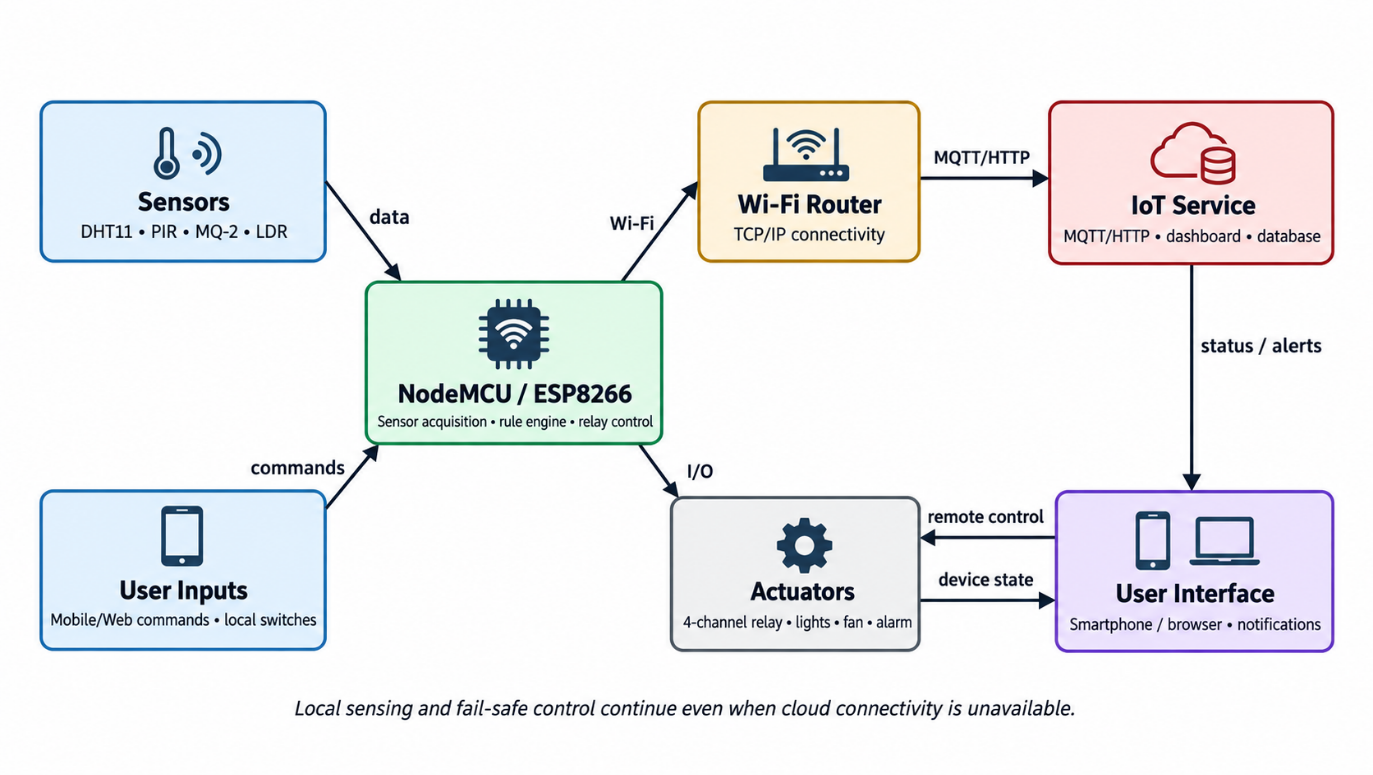
This methodology paper presents the design and implementation framework for a low-cost Internet of Things (IoT)-based smart home automation system that integrates environmental sensing, appliance control, safety monitoring, and remote user access. The proposed architecture uses a NodeMCU/ESP8266-class Wi-Fi microcontroller as the local controller, digital and analog sensors for temperature, humidity, motion, gas, and illumination, a relay interface for household loads, and an Internet service that supports message exchange and visualization through MQTT or HTTP. The method emphasizes modularity, local fail-safe operation, low deployment cost, and a layered security model. A step-by-step implementation procedure is defined for hardware assembly, firmware development, network configuration, dashboard creation, automation rules, and verification. The evaluation plan measures command-response time, command success rate, sensor update reliability, alert generation, energy-aware switching, and behavior during temporary Internet failure. Because no experimental dataset was supplied for this paper, the Results section reports reproducible acceptance criteria and expected system behavior rather than claiming unpublished field measurements. The overall design is consistent with IoT architecture, smart-home, monitoring, security, and energy-efficiency studies published up to 2019, and provides a practical methodology that can be implemented and empirically validated in a residential laboratory or prototype home.
Downloads
Downloads
Published
How to Cite
Issue
Section
License

This work is licensed under a Creative Commons Attribution-NoDerivatives 4.0 International License.
