
Implementation of IoT-Based Smart Home Automation for Energy Conservation and Security Enhancement
Keywords:
Abstract
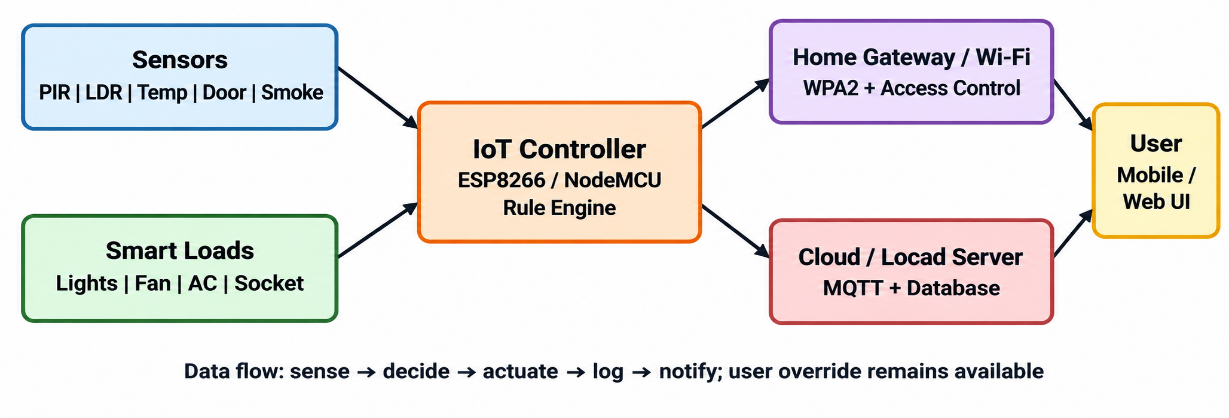
The Internet of Things (IoT) enables residential devices, sensors, actuators, and user interfaces to operate as a coordinated cyber-physical system. This methodology paper presents a practical framework for implementing an IoT-based smart home that addresses two closely related goals: reducing unnecessary household electricity consumption and strengthening domestic security. The proposed architecture uses low-cost Wi-Fi-enabled controllers, environmental and occupancy sensors, relay-based appliance control, an energy-monitoring layer, a secure local or cloud messaging service, and a mobile/web interface. Energy conservation is achieved through occupancy-aware lighting, temperature-based fan or air-conditioning control, standby-load disconnection, schedules, and real-time feedback. Security enhancement is achieved through motion, door/window, smoke or gas sensing, event logging, and authenticated alerts. The methodology specifies hardware integration, communication, automation rules, data acquisition, access-control safeguards, and a reproducible evaluation plan using energy reduction, response latency, event-detection rate, false-alarm rate, network reliability, and user-override success as performance indicators. Literature published through 2018 shows that IoT-based home energy management can improve monitoring and controllability, while smart-home connectivity simultaneously creates privacy and cyber-physical risks that must be addressed by design. Because this is a methodology-focused paper rather than a report of a completed long-term field deployment, the Results section presents a literature-calibrated validation framework and target ranges rather than fabricated measurements. The framework provides a technically feasible basis for a low-cost smart-home prototype that balances energy efficiency, occupant comfort, usability, and security.
Downloads
Downloads
Published
How to Cite
Issue
Section
License

This work is licensed under a Creative Commons Attribution-NoDerivatives 4.0 International License.
