
Design and Performance Analysis of IoT-Based Smart Home Automation Systems
Keywords:
Abstract
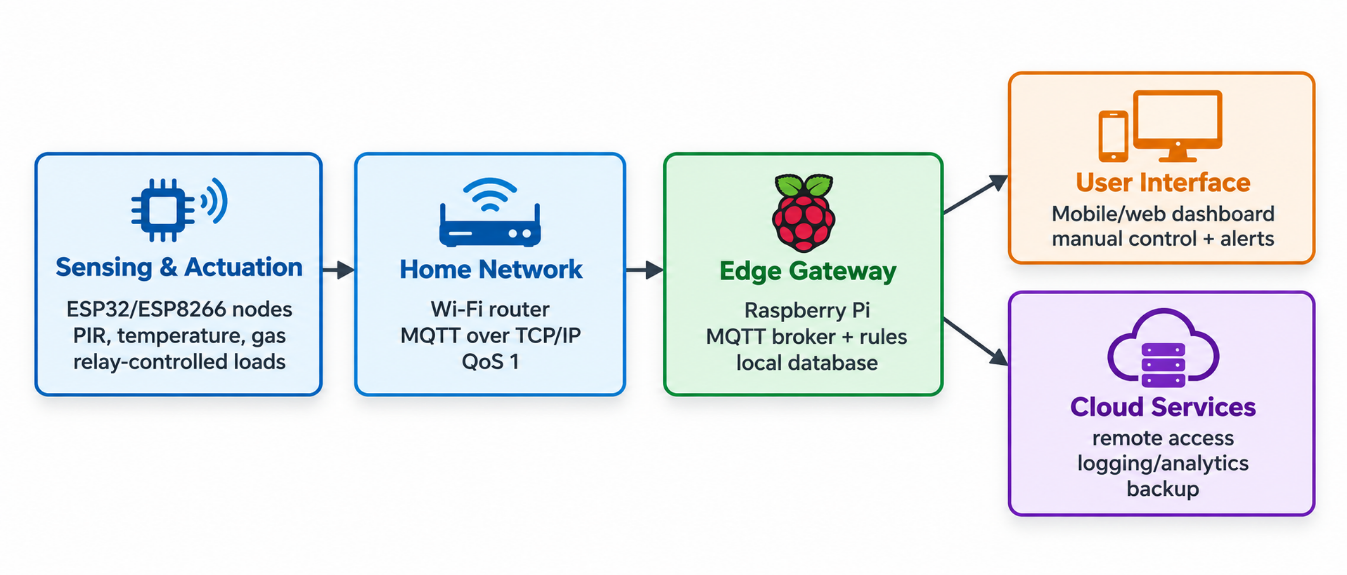
The Internet of Things (IoT) has transformed conventional home automation from isolated device control into a connected cyber-physical environment capable of sensing, communication, actuation, remote access, and rule-based decision making. This methodology paper presents a low-cost architecture and a reproducible procedure for evaluating the performance of an IoT-based smart home automation system. The proposed design combines Wi-Fi-enabled sensor/actuator nodes, an edge gateway, an MQTT message broker, local rule processing, and an optional cloud layer for remote visualization. Performance is assessed through command round-trip latency, 95th-percentile latency, successful command delivery, and effective throughput under increasing device loads. Because a physical laboratory testbed was not available for this paper, the reported results are generated from a controlled, deterministic simulation model and are presented as methodological evidence rather than as hardware measurements. The simulation indicates that MQTT with QoS 1 maintains lower response delay and a higher successful-delivery rate than a comparable HTTP/REST control path as device load increases. The paper also integrates security, privacy, interoperability, and local-fallback requirements drawn from prior smart-home research. The resulting methodology can be implemented directly on Raspberry Pi and ESP-class hardware and provides a transparent framework for later physical validation.
Downloads
Downloads
Published
How to Cite
Issue
Section
License

This work is licensed under a Creative Commons Attribution-NoDerivatives 4.0 International License.
