Finite Element Analysis of Mechanical Components Under Static and Dynamic Loading Conditions
DOI:
https://doi.org/10.65521/ijtarme.v6i1.4384Keywords:
Abstract
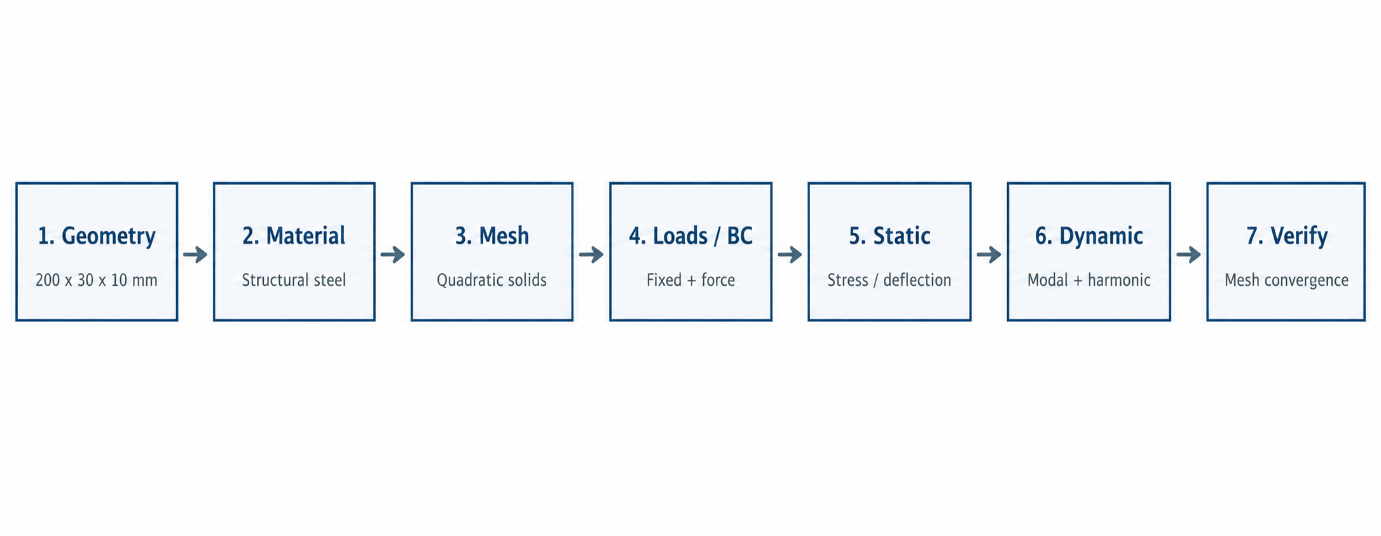
Finite element analysis (FEA) provides a unified numerical framework for evaluating the structural integrity and dynamic behavior of mechanical components before physical prototyping. This methodology paper presents a compact, reproducible procedure for static, modal, harmonic-response, and transient analyses using a structural-steel cantilever-type component as a benchmark. The model is discretized with three-dimensional solid elements, constrained at one end, and subjected to a transverse static load and frequency-dependent dynamic excitation. Mesh-convergence checks are used to establish solution independence, while analytical beam relations provide an additional verification route for stress, displacement, and the first natural frequency. The representative converged solution gives a maximum equivalent stress of approximately 195 MPa and a tip displacement of 2.62 mm under a 500 N static load; the corresponding first bending frequency is about 198.6 Hz. Harmonic analysis shows the expected resonance-sensitive amplification near the first mode, demonstrating why dynamic loading cannot be inferred safely from static results alone. The proposed workflow emphasizes realistic boundary conditions, verified material data, mesh refinement near stress gradients, damping assumptions, and comparison with analytical or experimental evidence. The paper is intended as a methodology template for brackets, connecting rods, shafts, blades, housings, and similar load-bearing mechanical components.