Optimization of CNC Turning Parameters for Improved Surface Finish and Material Removal Rate
DOI:
https://doi.org/10.65521/ijtarme.v6i1.4386Keywords:
Abstract
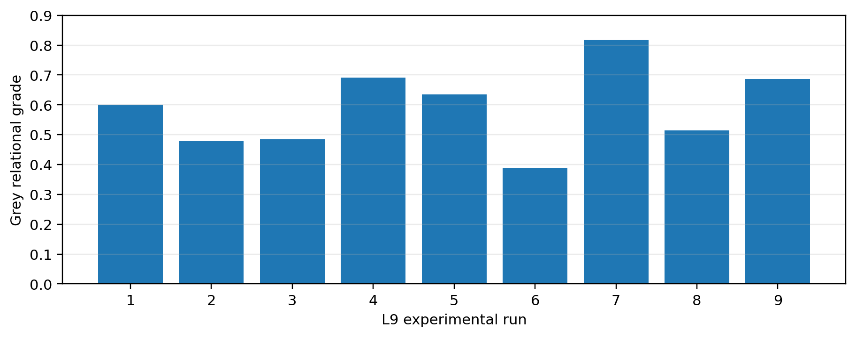
This paper presents a structured experimental methodology for optimizing computer numerical control (CNC) turning parameters to obtain a low surface roughness while maintaining a high material removal rate (MRR). The proposed framework considers cutting speed, feed rate and depth of cut as controllable factors and uses a Taguchi L9 orthogonal array to reduce the number of machining trials. Surface roughness (Ra) is treated as a smaller-the-better response, whereas MRR is treated as a larger-the-better response. Signal-to-noise ratios and analysis of variance (ANOVA) are used to identify factor influence, and Grey Relational Analysis (GRA) combines the two conflicting responses into a single optimization index. A representative L9 dataset is included to demonstrate the analysis sequence; these values are illustrative and should be replaced by measured values when the proposed experiment is implemented. The demonstration identifies a high cutting speed, low feed and high depth of cut as a favorable compromise, with the highest Grey Relational Grade occurring at 200 m/min, 0.10 mm/rev and 1.5 mm depth of cut. The methodology provides a reproducible basis for selecting CNC turning conditions where both product quality and machining productivity are important.