Optimization of Drilling Parameters for Improved Surface Quality Using Taguchi Method
DOI:
https://doi.org/10.65521/ijtarme.v4i1.4382Keywords:
Abstract
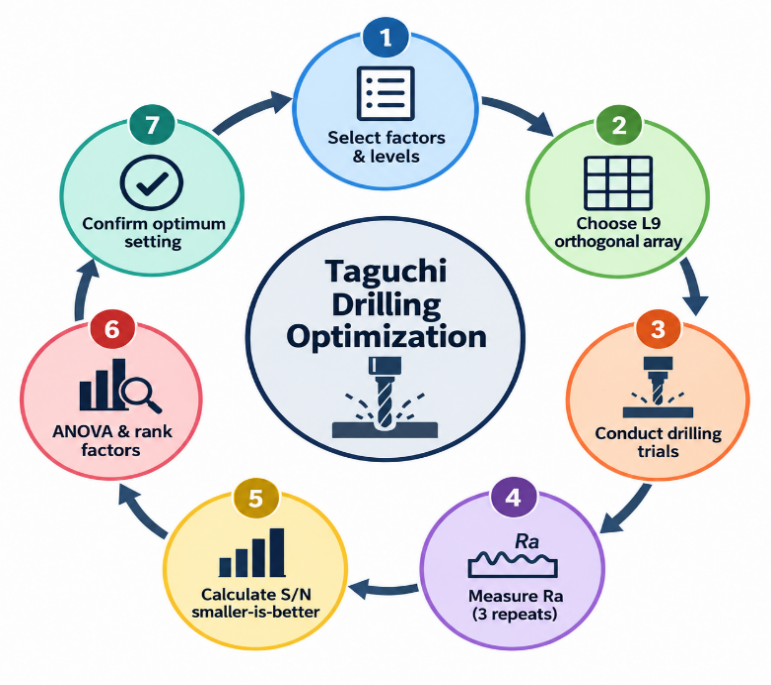
Surface quality in drilling is strongly influenced by machining parameters, and inappropriate parameter selection can produce rough hole surfaces, excessive thrust, tool wear, and dimensional errors. This methodology paper presents a Taguchi-based experimental framework for optimizing drilling parameters with average surface roughness (Ra) as the primary quality response. A three-factor, three-level L9 orthogonal array is formulated using spindle speed, feed rate, and drill point angle. Each trial is repeated three times, and the results are analyzed using the smaller-is-better signal-to-noise (S/N) ratio, response means, and analysis of variance (ANOVA). A representative dataset is included to demonstrate the complete statistical workflow without claiming unperformed laboratory measurements. The illustrative analysis identifies feed rate as the dominant factor, followed by spindle speed and point angle. The predicted optimal combination is 1400 rpm spindle speed, 0.05 mm/rev feed, and 118-degree point angle. A confirmation result near 0.78 micrometre Ra would represent an improvement of approximately 45% relative to a central-setting condition. The proposed methodology provides a compact, reproducible procedure that can be applied to aluminium alloys, steels, and other engineering materials after suitable adjustment of parameter ranges.