Experimental Study of Heat Transfer Enhancement Using Extended Surfaces in Heat Exchangers
DOI:
https://doi.org/10.65521/ijtarme.v4i1.4442Keywords:
Abstract
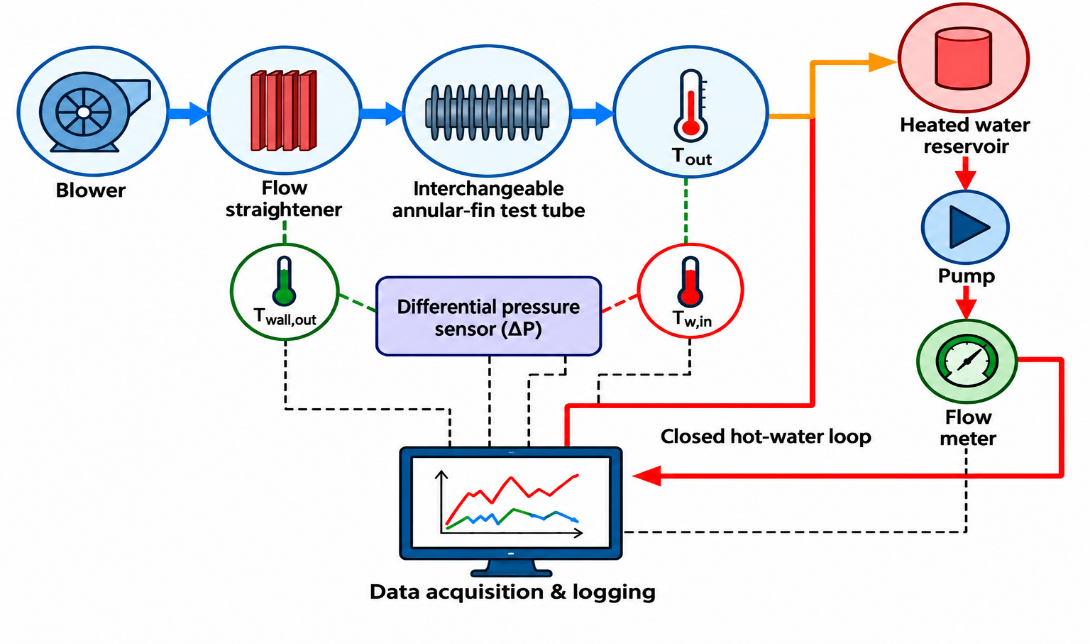
Extended surfaces are a passive heat-transfer enhancement technique used to increase the effective area available for convection without proportionally increasing heat-exchanger volume. This methodology paper develops an experimental procedure for quantifying the thermal and hydraulic effects of annular fins on a cross-flow air-to-water heat exchanger. Three interchangeable copper-tube configurations are considered: a bare tube, a tube fitted with aluminum annular fins at 10 mm pitch, and a tube with fins at 5 mm pitch. Hot water is circulated through the tube while ambient air is forced across the external surface in an insulated duct. Inlet and outlet temperatures, air velocity, water flow rate, and air-side pressure drop are recorded under steady-state conditions. Heat-transfer rate, heat balance, effectiveness, Reynolds number, surface-area ratio, and enhancement ratio are calculated from the measurements, while pressure drop is used to evaluate the pumping/fan penalty. The proposed test matrix spans air velocities of 1–5 m/s at a nominal hot-water inlet temperature of 70 °C. Representative processed values show the expected trend that closer fin spacing yields the largest heat-transfer gain, but also the greatest pressure-drop penalty. The methodology therefore emphasizes simultaneous thermal and hydraulic evaluation rather than heat-transfer rate alone. The procedure is suitable for instructional laboratories and for comparative screening of extended-surface geometries before detailed optimization.