Design and Thermal Analysis of Solar Air Heaters for Industrial Heating Applications
DOI:
https://doi.org/10.65521/ijtarme.v8i1.4400Keywords:
Abstract
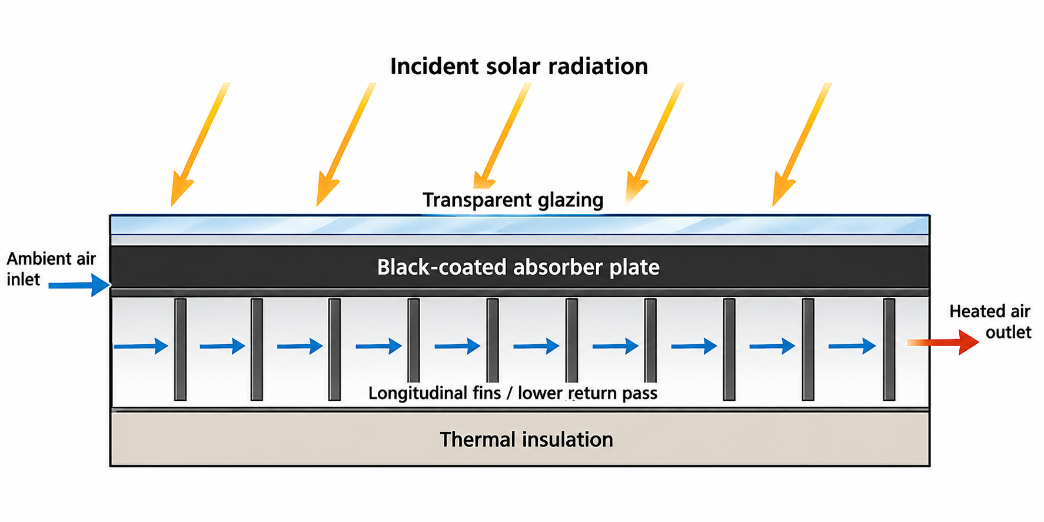
Solar air heaters offer a direct and mechanically simple route for converting solar radiation into useful sensible heat for low- and medium-temperature industrial processes. Their wider application is nevertheless constrained by the low convective heat-transfer coefficient of air, thermal losses from the collector, and the pumping penalty associated with aggressive heat-transfer enhancement. This methodology paper develops a compact design and thermal-analysis framework for a forced-convection, single-pass solar air heater intended for industrial preheating and drying duties. The proposed collector combines a black selective absorber, single glazing, insulated casing, and a rib-enhanced air channel. The method links solar energy balance, internal forced convection, pressure-drop estimation, and performance indicators including useful heat gain, outlet-air temperature, thermal efficiency, Reynolds number, and thermohydraulic behavior. A nominal 2.0 m² collector is analyzed at an inlet temperature of 30 °C, irradiance near 800 W/m², and air mass-flow rates of 0.02–0.05 kg/s. Model-based results indicate the expected design trade-off: increasing mass flow raises collector efficiency from approximately 45% to 62% but reduces the temperature lift from about 36 °C to 20 °C while increasing pressure drop. The framework therefore supports selection of an operating point according to the industrial process temperature requirement rather than thermal efficiency alone. The paper also integrates findings from solar-air-heater research published up to 2019 and provides a reproducible step-by-step methodology for later experimental or CFD validation.