Thermal Performance Analysis of Heat Exchangers Using Nanofluids for Energy-Efficient Applications
DOI:
https://doi.org/10.65521/ijtarme.v11i1.4424Keywords:
Abstract
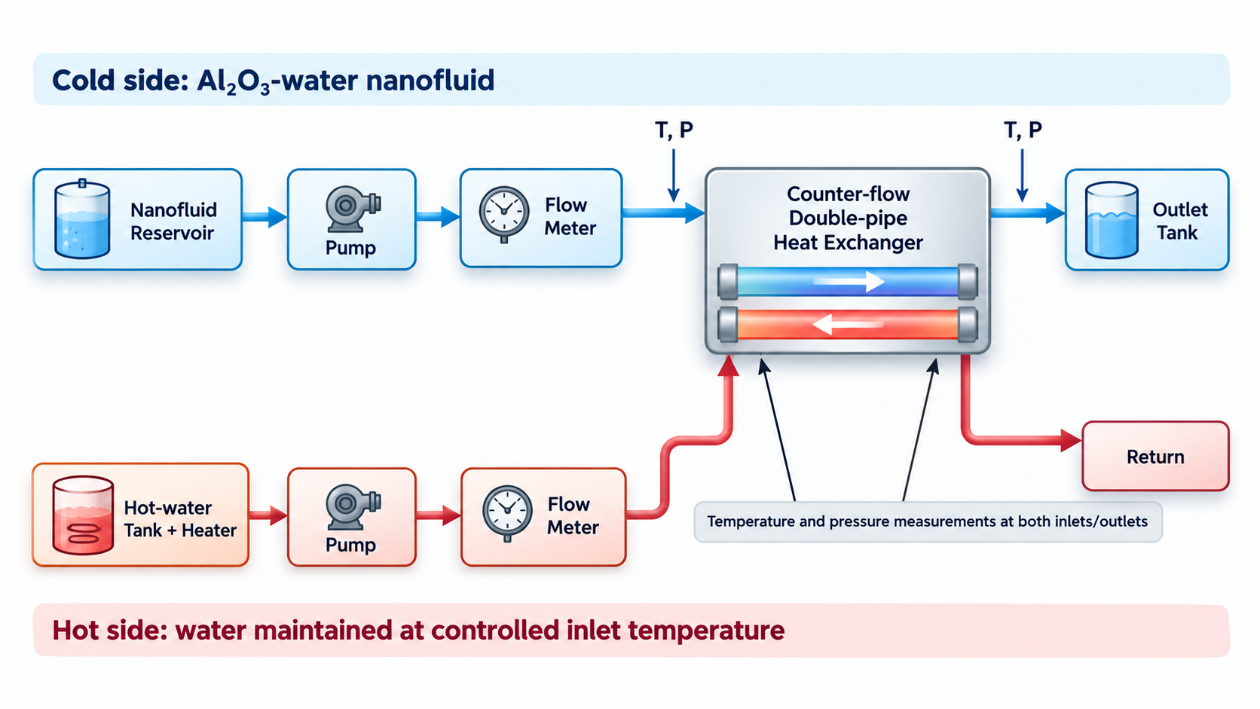
Heat exchangers are central to energy conversion, refrigeration, process industries, power systems and waste-heat recovery, yet their efficiency is constrained by the limited thermal conductivity of conventional working fluids. This methodology paper develops a reproducible framework for evaluating the thermal and hydraulic performance of a counter-flow double-pipe heat exchanger operated with Al2O3-water nanofluids. The proposed study varies nanoparticle volume concentration from 0 to 2.0% and Reynolds number from 6,000 to 14,000 while controlling hot- and cold-stream inlet conditions. Effective density, specific heat, viscosity and thermal conductivity are determined from standard mixture models, and exchanger performance is evaluated through heat-transfer rate, log-mean temperature difference, overall and convective heat-transfer coefficients, Nusselt number, pressure drop, pumping power and a thermal performance evaluation criterion. A literature-informed, model-based results section is included to demonstrate the analysis workflow without presenting unperformed laboratory measurements as experimental facts. At Re = 10,000, the conservative single-phase model predicts that increasing Al2O3 concentration to 2.0 vol.% raises the convective heat-transfer coefficient by about 3.0% while pressure drop rises by about 4.4%, producing a performance criterion slightly above unity. The analysis indicates that low-to-moderate nanoparticle concentrations can provide a positive thermal-hydraulic balance, but practical energy savings depend on dispersion stability, viscosity, pumping power and heat-exchanger geometry. The methodology can be used as a basis for laboratory validation and for comparing different nanoparticle/base-fluid combinations in energy-efficient thermal systems.