Stress and Deformation Analysis of Mechanical Components Using Finite Element Method
DOI:
https://doi.org/10.65521/ijtarme.v4i1.4380Keywords:
Abstract
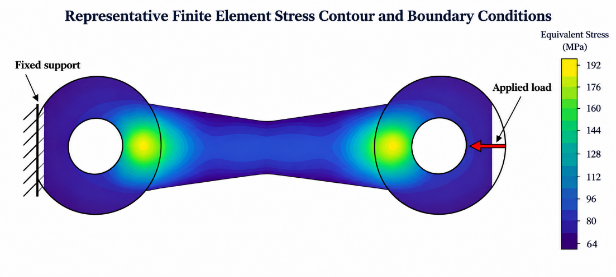
Finite element analysis (FEA) provides a systematic numerical framework for estimating stress, strain and deformation in mechanical components whose geometry, loading and boundary conditions make closed-form analysis difficult. This methodology paper develops a reproducible procedure for linear-elastic structural analysis of a representative mechanical connecting-link component, while keeping the workflow general enough for brackets, shafts, connecting rods, gear bodies and similar load-carrying parts. The procedure includes geometry idealization, material definition, load conversion, contact and support assumptions, element selection, mesh refinement, solver setup, convergence assessment and interpretation of equivalent stress and total deformation. A generic steel component with two pin holes and a filleted shank is used to demonstrate the method. Representative results show that peak von Mises stress stabilizes near 198 MPa as the mesh is refined and the maximum deformation approaches 0.252 mm for the governing 20 kN load case. The converged response is below the assumed material yield strength of 355 MPa, giving a static factor of safety of approximately 1.79. The paper emphasizes that mesh independence, realistic constraints and engineering validation are more important than simply obtaining a colored contour plot. The proposed framework supports repeatable design assessment and can be extended to nonlinear, contact, thermal-stress, fatigue and dynamic investigations when required.