Finite Element Analysis of Automotive Chassis Under Static and Dynamic Loading Conditions
DOI:
https://doi.org/10.65521/ijtarme.v7i1.4389Keywords:
Abstract
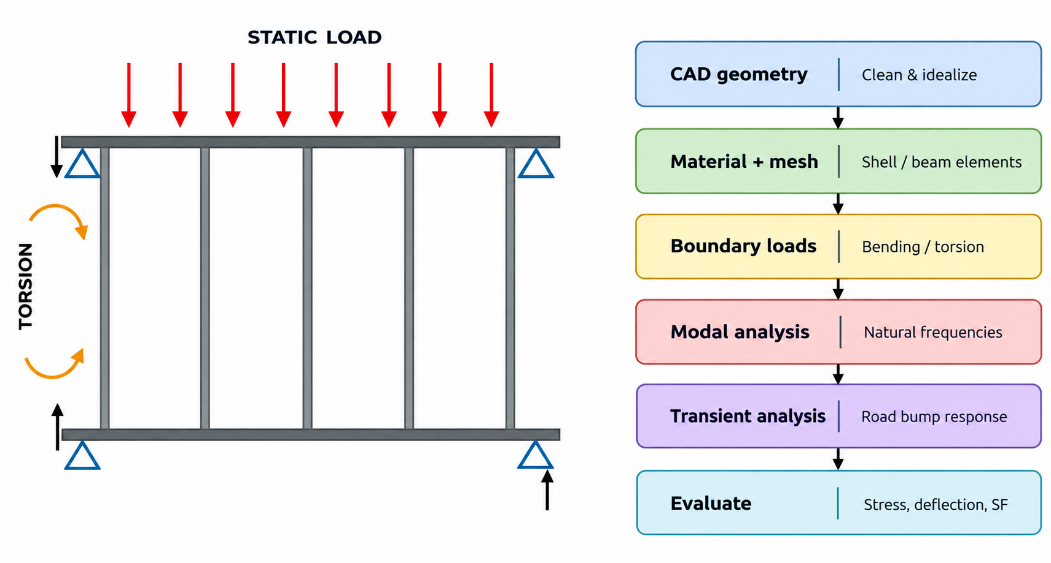
T This paper presents a compact methodology for evaluating the structural performance of an automotive ladder-type chassis under static and dynamic loading using finite element analysis (FEA). The proposed procedure integrates CAD idealization, material definition, mesh convergence, realistic suspension constraints, static bending and torsional load cases, modal extraction, and a transient road-bump load. A representative structural-steel chassis is used as a benchmark case so that stresses, deflections, torsional stiffness, natural frequencies, and factors of safety can be interpreted within one consistent framework. The benchmark results indicate that the highest static stress occurs near suspension/cross-member junctions, while a short-duration bump produces the governing dynamic stress. Modal analysis identifies low-order bending and torsional modes that should be kept away from dominant road and powertrain excitation ranges. The study also emphasizes mesh sensitivity and the need to represent joints and load paths correctly. The methodology is intended for preliminary design screening and optimization before prototype testing. Because the reported numerical values are generated for the stated benchmark model rather than a physical test vehicle, they should be replaced or validated with solver and experimental data when the work is submitted as an experimental research article.