Finite Element Analysis of Lightweight Composite Structures for Automotive Applications
DOI:
https://doi.org/10.65521/ijtarme.v9i1.4413Keywords:
Abstract
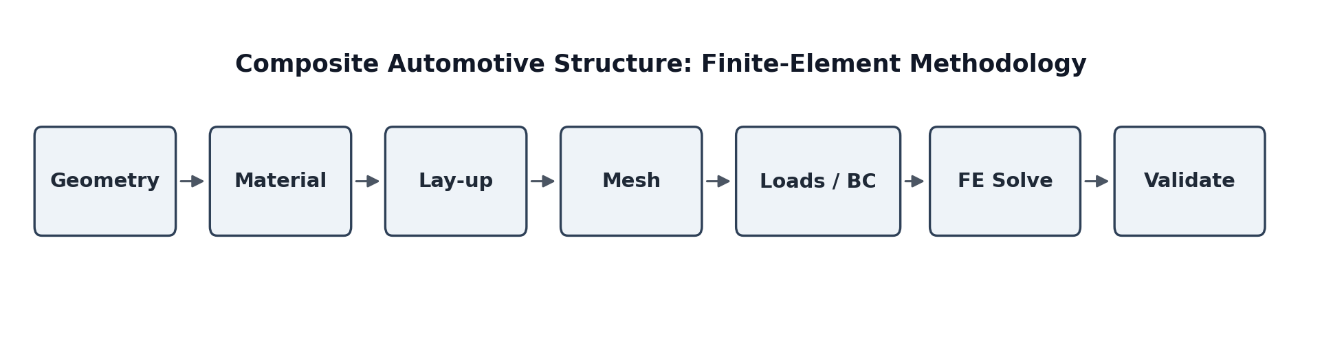
Lightweight structural design is a central requirement in modern automotive engineering because reduction of vehicle mass can improve energy efficiency, driving range, and dynamic performance while preserving crashworthiness. This paper presents a finite-element methodology for evaluating fiber-reinforced composite alternatives to a conventional steel automotive structural member. A representative thin-walled cross-member is modeled using a common external geometry and is assessed using steel, glass-fiber-reinforced polymer (GFRP), and carbon-fiber-reinforced polymer (CFRP) designs. The composite variants are represented as orthotropic laminated shells with a balanced [0/45/90/-45]s architecture, while the steel baseline is modeled as isotropic. The workflow combines geometry idealization, laminate definition, mesh convergence, boundary-condition application, static structural analysis, composite failure assessment, and mass-normalized performance comparison. Numerical outputs include displacement, stress or failure index, structural mass, stiffness-to-mass ratio, and predicted weight saving. The simulation-based case study indicates that a properly tailored CFRP member can provide the highest specific stiffness and the largest mass reduction while maintaining a failure index below unity. GFRP also offers substantial weight savings, although its lower longitudinal stiffness results in greater deformation than CFRP for comparable load cases. The study demonstrates how finite element analysis can be used as a systematic screening tool before detailed crash, fatigue, manufacturing, and experimental validation. The proposed method is suitable for early-stage design of automotive body, chassis, roof, hood, bumper, and energy-absorbing composite structures.