
A Comparative Study of Load Balancing Algorithms in Cloud Computing Environments
Keywords:
Abstract
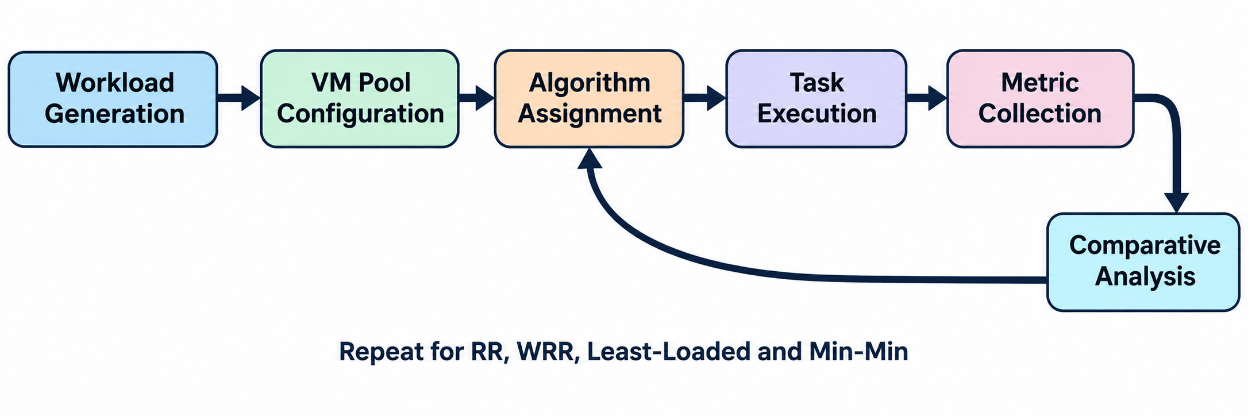
Load balancing is a central resource-management function in cloud computing because virtualized infrastructures must distribute heterogeneous and time-varying workloads without creating persistent hotspots or leaving expensive resources idle. This methodology paper presents a controlled comparative framework for evaluating four representative algorithms: Round Robin (RR), Weighted Round Robin (WRR), Least-Loaded or active-monitoring allocation, and Min-Min scheduling. The evaluation uses a reproducible discrete-event model based on the virtual-machine and task abstractions popularized by CloudSim. A heterogeneous pool of 20 virtual machines executes 300 independent computational tasks, while makespan, average response time, throughput, resource utilization, and degree of imbalance are measured under identical workloads. The representative experiment shows that RR is simple but performs poorly when VM capacities differ; WRR improves balance by incorporating processing weights; Least-Loaded provides the lowest average response time and the smallest imbalance; and Min-Min obtains the best makespan by selecting the task-resource pair with the earliest projected completion time. The findings support the broader literature that dynamic or state-aware methods provide stronger performance in heterogeneous clouds, although they impose higher scheduling overhead. The paper therefore provides a step-by-step methodology that can be replicated or extended in CloudSim or other cloud simulators for larger workloads, energy-aware policies, or network-sensitive scenarios.
Downloads
Downloads
Published
How to Cite
Issue
Section
License

This work is licensed under a Creative Commons Attribution-NoDerivatives 4.0 International License.
