
Optimization Of Cloud Computing Resource Allocation Using Hybrid Metaheuristic Techniques
Keywords:
Abstract
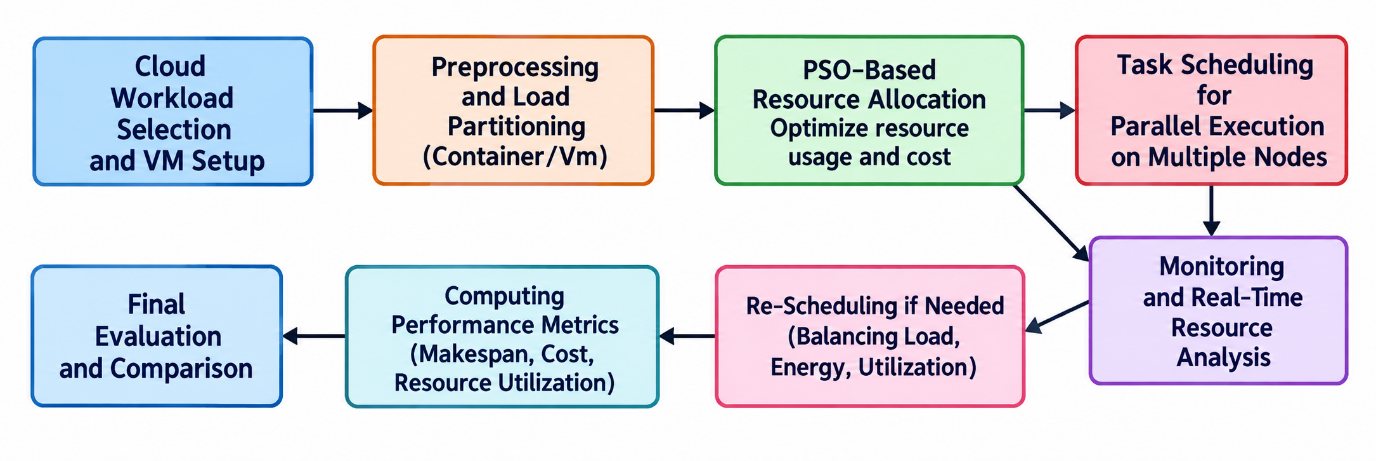
Efficient resource allocation is central to cloud computing because heterogeneous virtual machines must serve dynamic workloads while simultaneously controlling response time, operating cost, energy use, and service-level performance. Exact optimization becomes impractical as the number of tasks and resources increases, motivating metaheuristic scheduling methods. This methodology paper proposes a Hybrid Genetic Algorithm–Particle Swarm Optimization (HGA–PSO) framework for mapping independent cloud tasks to heterogeneous virtual machines. The genetic stage emphasizes global exploration through population selection, crossover, and mutation, whereas the particle-swarm stage refines elite schedules through guided exploitation. A normalized multi-objective fitness function combines makespan, monetary execution cost, estimated energy consumption, and resource utilization. The evaluation uses a reproducible synthetic cloud-resource simulator with 10 heterogeneous virtual machines and workloads of 100, 250, and 500 tasks. Three independent random seeds are used for each workload size. The proposed hybrid method is compared with Round Robin, standalone GA, and standalone PSO. For the 500-task workload, HGA–PSO reduces mean makespan from 2696.71 s under Round Robin to 1144.50 s and improves mean utilization from 50.21% to 98.76%. Compared with GA, it reduces makespan by approximately 4.5% and energy by about 2.6%, while incurring only a small cost increase. The method therefore offers a practical exploration–exploitation balance for multi-criteria cloud allocation, especially where responsiveness and energy efficiency are prioritized together.
Downloads
Downloads
Published
How to Cite
Issue
Section
License

This work is licensed under a Creative Commons Attribution-NoDerivatives 4.0 International License.
