
Optimization of Cloud Computing Resource Allocation Using Evolutionary Algorithms
Keywords:
Abstract
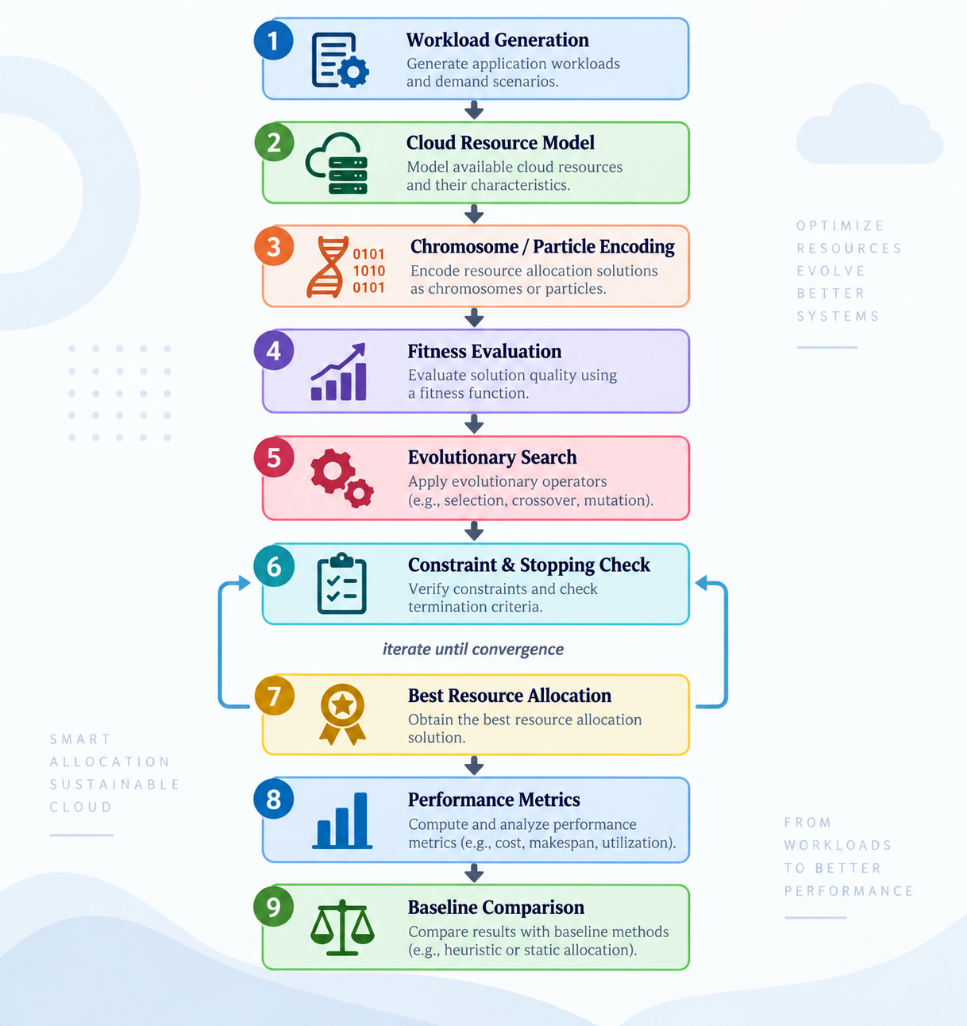
Cloud computing depends on efficient allocation of heterogeneous virtualized resources to workloads whose processing demands vary over time. Static or rule-based allocation can leave fast virtual machines underused while slower instances become overloaded, increasing application completion time and weakening quality-of-service performance. This methodology paper develops and evaluates an evolutionary resource-allocation framework in which task-to-virtual-machine mappings are optimized using a Genetic Algorithm (GA) and a discrete Particle Swarm Optimization (PSO) method. The objective combines normalized makespan, monetary execution cost, and load imbalance so that a scheduler does not optimize one measure at the expense of all others. A reproducible simulation is defined with 120 independent tasks and 10 heterogeneous virtual machines ranging from 1,200 to 5,200 MIPS. Evolutionary solutions are compared with Round-Robin and random allocation. Across 12 independent optimization runs, the GA obtains a mean makespan of 61.28 s and the PSO method 61.21 s, compared with 157.16 s for Round-Robin. Mean resource utilization increases from 48.1% under Round-Robin to about 98.3% under the evolutionary methods, while modeled execution cost changes only slightly. The results demonstrate why population-based search is suitable for the combinatorial allocation problem: it can explore many candidate mappings and rapidly converge toward balanced schedules on heterogeneous resources. The paper provides a clear experimental procedure that can be implemented directly in CloudSim or a comparable simulator for larger workloads and additional service-level constraints.
Downloads
Downloads
Published
How to Cite
Issue
Section
License

This work is licensed under a Creative Commons Attribution-NoDerivatives 4.0 International License.
