
A Comparative Study of Load Balancing Techniques in Cloud Computing Environments
Keywords:
Abstract
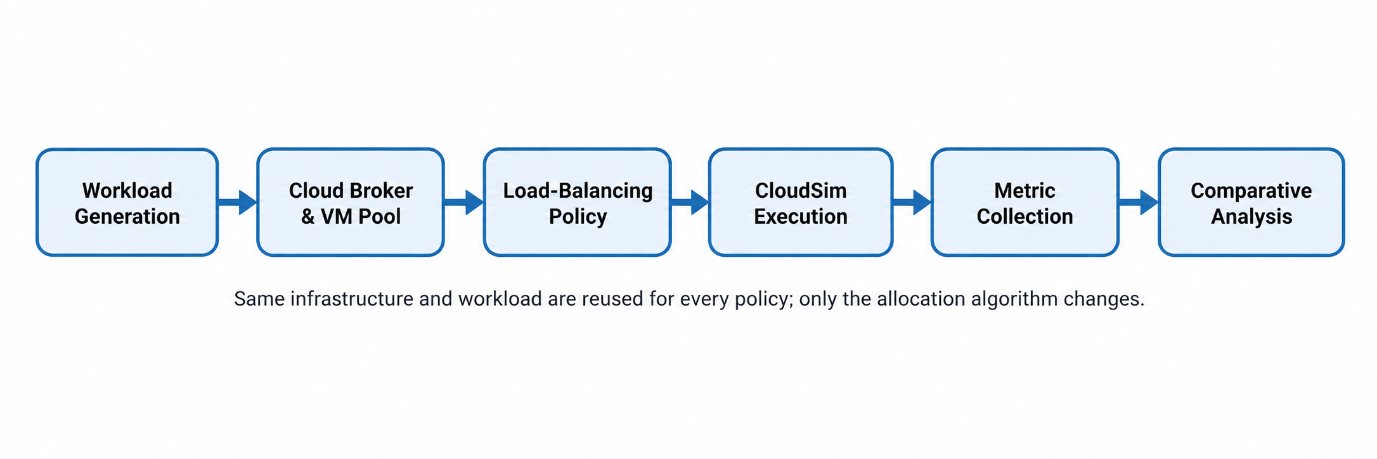
Cloud computing relies on elastic, virtualized pools of computing resources, but the performance of such pools depends strongly on how incoming tasks are distributed among virtual machines (VMs). Uneven assignment can create overloaded VMs, idle capacity, long response time, and poor service-level performance. This methodology paper presents a controlled comparative framework for four representative load-balancing techniques: Round Robin (RR), Throttled load balancing, Min-Min scheduling, and Honey Bee Behavior Inspired Load Balancing (HBB-LB). The study uses a reproducible discrete-event simulation design, informed by CloudSim modeling principles, to hold infrastructure and workload conditions constant while changing only the allocation policy. Performance is evaluated using average response time, makespan, throughput, resource utilization, and degree of imbalance across three workload levels. The results indicate that dynamic and workload-aware techniques provide more stable performance than simple cyclic allocation as workload intensity increases. In the defined simulation, HBB-LB and Min-Min provide the strongest overall performance, while Throttled allocation also achieves very low imbalance. The findings support the use of adaptive load-balancing policies for heterogeneous or bursty cloud environments and demonstrate a reproducible methodology for selecting an algorithm according to Quality-of-Service (QoS) objectives rather than relying on a single performance metric.
Downloads
Downloads
Published
How to Cite
Issue
Section
License

This work is licensed under a Creative Commons Attribution-NoDerivatives 4.0 International License.
