FPGA-Based Digital Signal Processing Architecture for Real-Time Communication Applications
DOI:
https://doi.org/10.65521/ijaeee.v5i1.4590Keywords:
Abstract
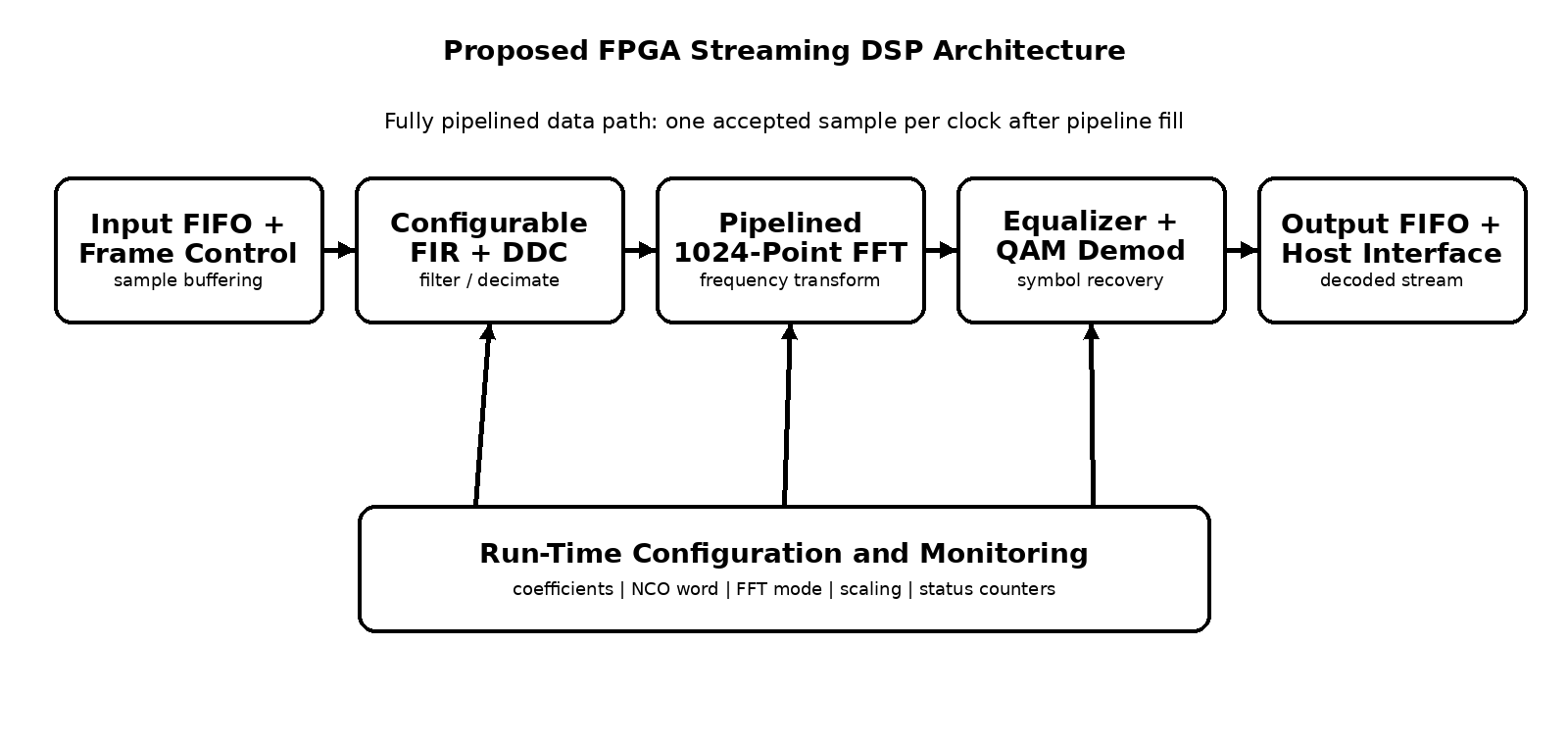
Field-programmable gate arrays (FPGAs) are attractive for real-time communication processing because their configurable logic, embedded multipliers, block memories, and deterministic pipelines can execute multiple signal-processing operations concurrently. This paper develops a methodology for an FPGA-based digital signal processing architecture intended for real-time communication applications. The architecture combines a streaming input interface, FIFO buffering, reconfigurable finite-impulse-response filtering and digital down-conversion, a pipelined 1024-point fast Fourier transform, equalization, quadrature-amplitude-modulation demodulation, and a low-overhead control plane. The design method emphasizes fixed-point word-length selection, dataflow partitioning, pipeline balancing, memory organization, timing closure, and verification against a floating-point reference model. Prior work on reconfigurable filters, filter-bank channelizers, systolic transforms, software-defined radio, and FPGA power-performance analysis provides the technical basis for the approach [1]-[10]. Instead of presenting unverified hardware measurements, the Results section reports architecture-level analytical benchmarks under a clearly stated 100 MHz design assumption. The modeled streaming pipeline sustains one accepted sample per clock after fill, while frame-based FFT processing is scheduled so that a 1024-sample frame can be accepted every 10.24 microseconds at 100 MHz. The methodology is suitable for FPGA implementations of software-defined radio, OFDM receivers, channelizers, spectrum-monitoring blocks, and other latency-sensitive communication systems.