Comparative Performance Analysis of PID and Fuzzy Logic Controllers for DC Motor Speed Regulation
DOI:
https://doi.org/10.65521/ijaeee.v5i1.4584Keywords:
Abstract
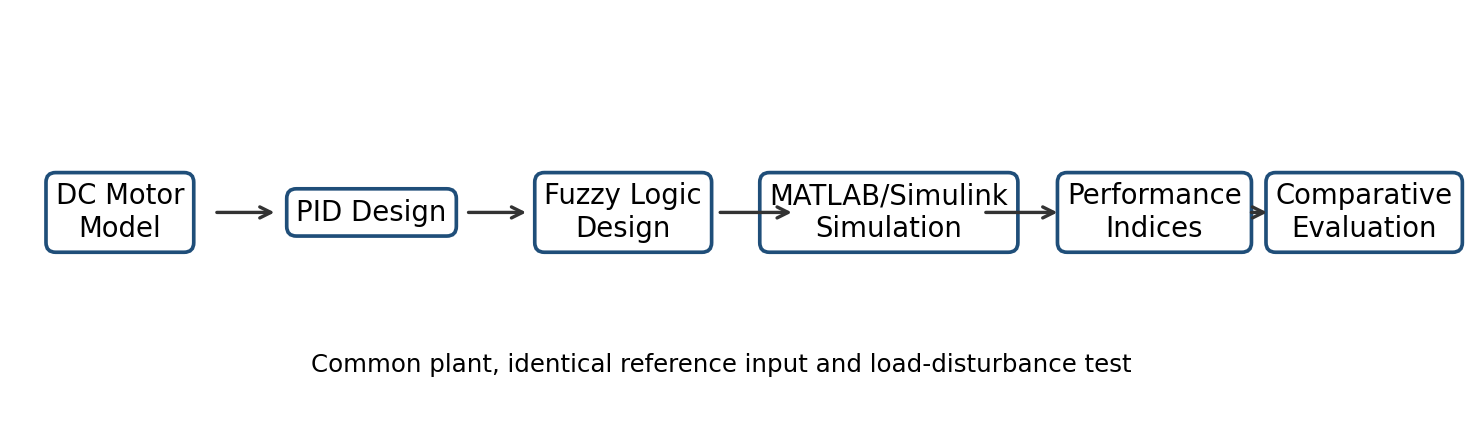
This paper presents a reproducible methodology for comparing a conventional proportional-integral-derivative (PID) controller with a fuzzy logic controller (FLC) for closed-loop speed regulation of a separately excited DC motor. A common electromechanical motor model, identical reference-speed command, actuator saturation and load-disturbance profile are used so that differences arise from the controller rather than the plant. The PID design uses fixed gains with derivative filtering and anti-windup, whereas the FLC uses speed error and change of error as linguistic inputs, five triangular membership functions per input, a 25-rule base and centroid-equivalent weighted defuzzification. The controllers are evaluated through rise time, settling time, percentage overshoot, steady-state error and disturbance recovery. In the illustrative simulation developed for this methodology, PID regulation gives a faster rise and settling response and stronger recovery from the applied load torque, while the FLC reduces overshoot and retains the practical advantage of rule-based control with limited dependence on an exact plant model. The study therefore emphasizes that controller selection should be based on the required trade-off among transient speed, overshoot, modeling effort and robustness rather than on a single performance index.