Comparative Study of PID and Fuzzy Logic Controllers for DC Motor Speed Regulation
DOI:
https://doi.org/10.65521/ijaeee.v6i1.4569Keywords:
Abstract
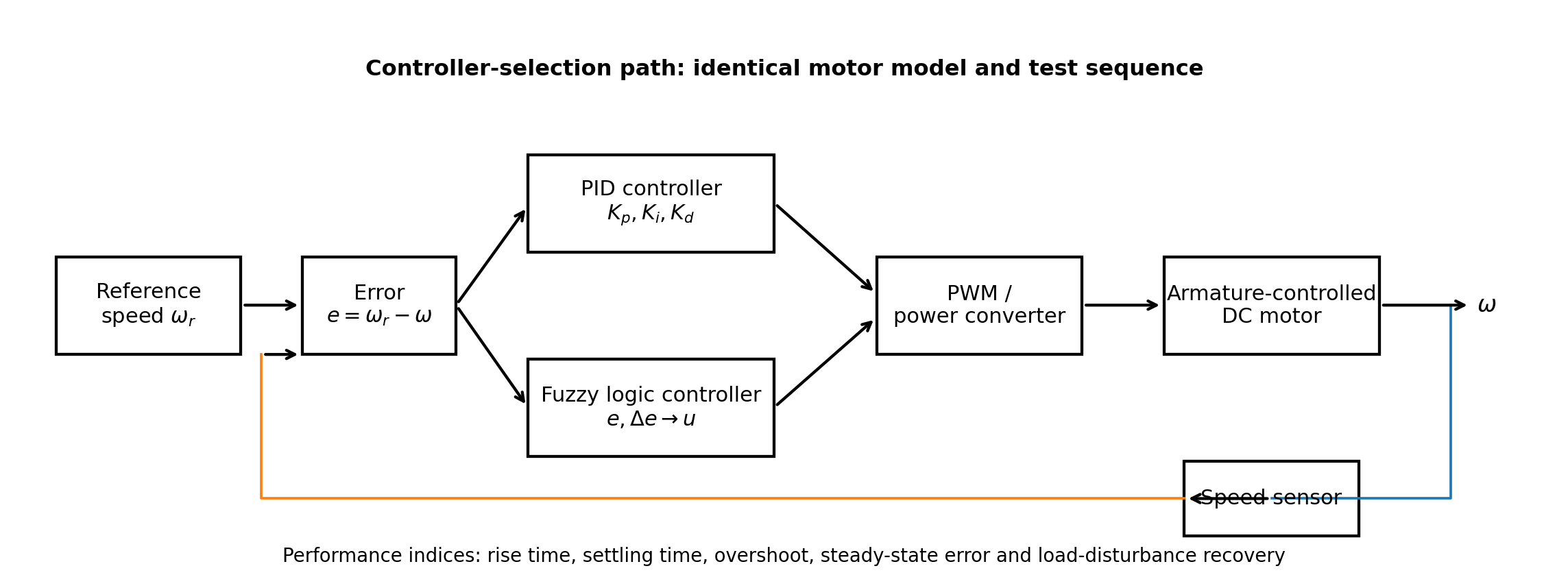
This paper presents a comparative methodology for regulating the speed of an armature-controlled direct-current (DC) motor using a conventional proportional-integral-derivative (PID) controller and a fuzzy logic controller (FLC). The comparison is structured around a common motor model, identical reference-speed commands, a step load disturbance, and standard time-domain indices. The PID controller is tuned to provide a stable compromise between rise time, overshoot and steady-state accuracy, while the FLC uses speed error and change of error as linguistic inputs to produce an incremental control action. The methodology follows the established roles of PID control in industrial regulation and fuzzy logic in nonlinear or uncertain systems [1]-[3]. A representative simulation scenario is then used to demonstrate how both controllers can be assessed under the same operating conditions. The illustrative results show that the fuzzy logic controller can reduce overshoot and settling time and can recover more quickly after a load disturbance, whereas the PID controller remains attractive because of its simplicity, transparent tuning parameters and low computational burden. The study therefore provides a reproducible framework for selecting a controller according to transient-performance, robustness and implementation requirements. The numerical results reported here are simulation-based and are not presented as physical prototype measurements.