Comparative Study of PID and Fuzzy Logic Controllers for DC Motor Speed Control
DOI:
https://doi.org/10.65521/ijaeee.v4i1.4564Keywords:
Abstract
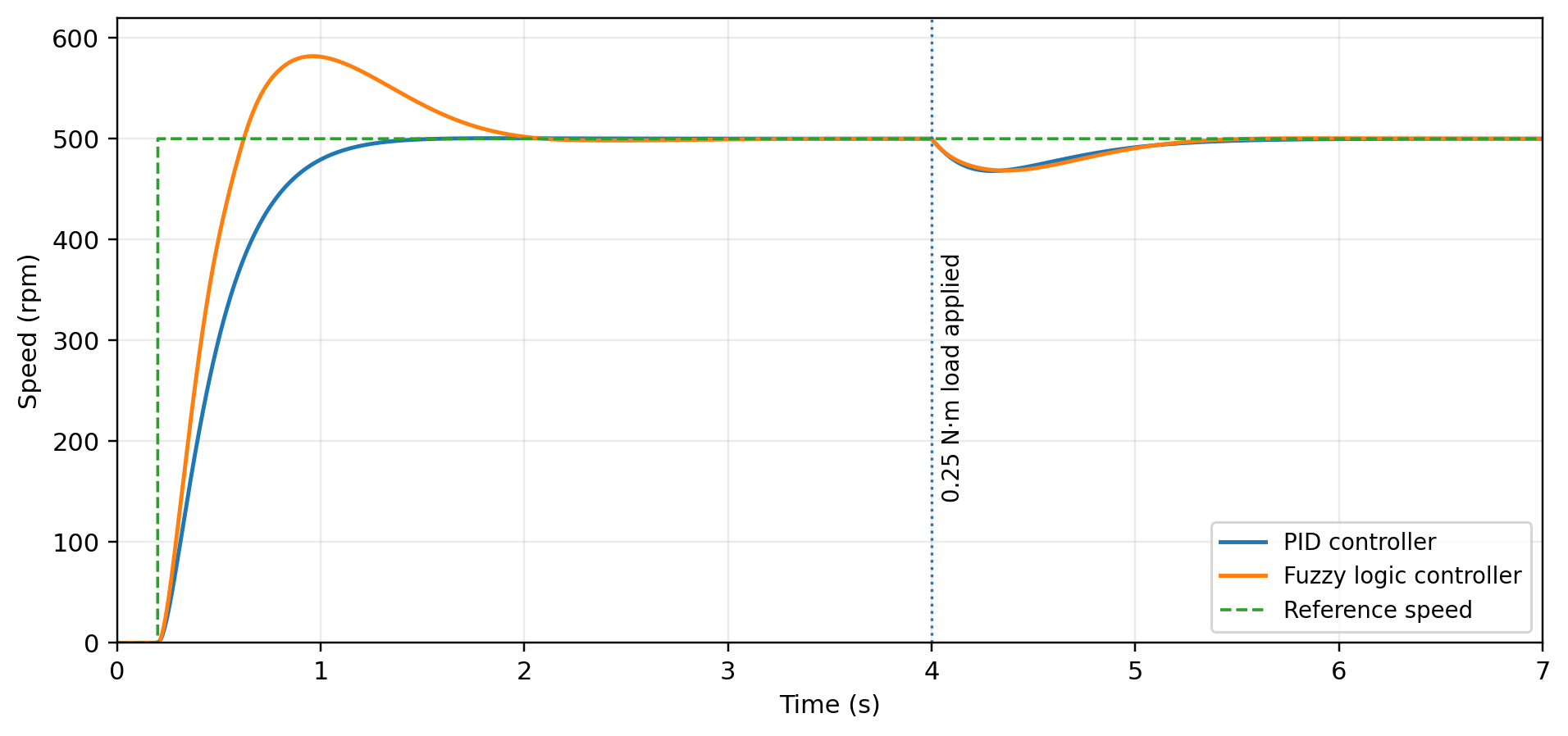
This paper presents a comparative methodology for proportional-integral-derivative (PID) and fuzzy logic control of a permanent-magnet DC motor. The study uses the same motor model, actuator voltage limit, reference command, and load-disturbance profile so that the two control strategies are evaluated under identical conditions. A conventional PID controller is implemented using speed error, integral action, and derivative action, while a Mamdani-type fuzzy controller uses speed error and change of error with five linguistic sets and a rule base, together with a small integral bias to remove steady-state offset. The motor is commanded from rest to 500 rpm and a 0.25 N·m load disturbance is applied at 4 s. Performance is assessed using rise time, settling time, percentage overshoot, steady-state error, disturbance-induced speed drop, and recovery time. In the simulation reported here, the fuzzy controller provides a faster rise time (0.298 s versus 0.547 s), whereas the PID controller gives much lower overshoot (0.10% versus 16.36%) and a shorter nominal settling time. Disturbance rejection is similar for the two controllers. The comparison therefore shows that controller selection should be based on the required balance among rapid acceleration, damping, robustness, and implementation complexity rather than on a single performance index.