Comparative Thermoluminescence and Trap-Kinetic Analysis of Rare-Earth-Codoped Aluminate Phosphors
DOI:
https://doi.org/10.65521/apl.v4i1.4195Keywords:
Abstract
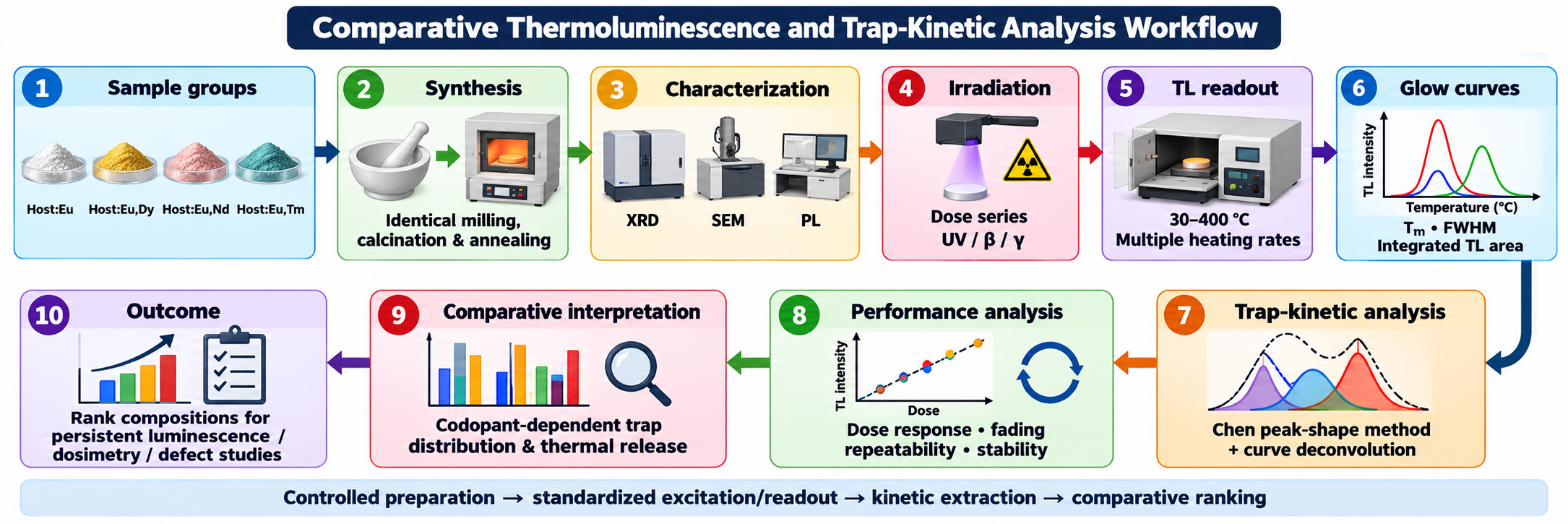
Thermoluminescence (TL) is a thermally stimulated emission process that provides direct information on charge-trapping defects, trap depth, recombination kinetics, and radiation-response behavior in insulating and semiconducting phosphors. This methodology paper proposes a systematic investigation of rare-earth-doped phosphor materials, with emphasis on Eu-activated and Eu/Dy- or Eu/R-codoped alkaline-earth aluminates. The proposed workflow combines controlled synthesis, structural and optical characterization, irradiation, glow-curve acquisition, dose-response testing, heating-rate studies, fading measurements, and kinetic analysis using peak-shape and computerized glow-curve deconvolution methods. The design is grounded exclusively in literature published up to 2015. Earlier work established that rare-earth codopants can strongly modify trap populations and glow-peak positions, while SrAl2O4:Eu2+,Dy3+ and related aluminates show persistent luminescence linked to thermally released trapped charge. The expected outcome is a reproducible relationship between dopant chemistry, glow-curve structure, activation energy, frequency factor, kinetic order, and integrated TL intensity. The methodology is suitable for screening phosphors for radiation dosimetry, persistent-luminescence devices, defect studies, and temperature-sensitive applications without claiming experimental values that have not yet been measured.