Automatic Street Light Control System Using Light Dependent Sensors
DOI:
https://doi.org/10.65521/itsi-teee.v7i1.4235Keywords:
Abstract
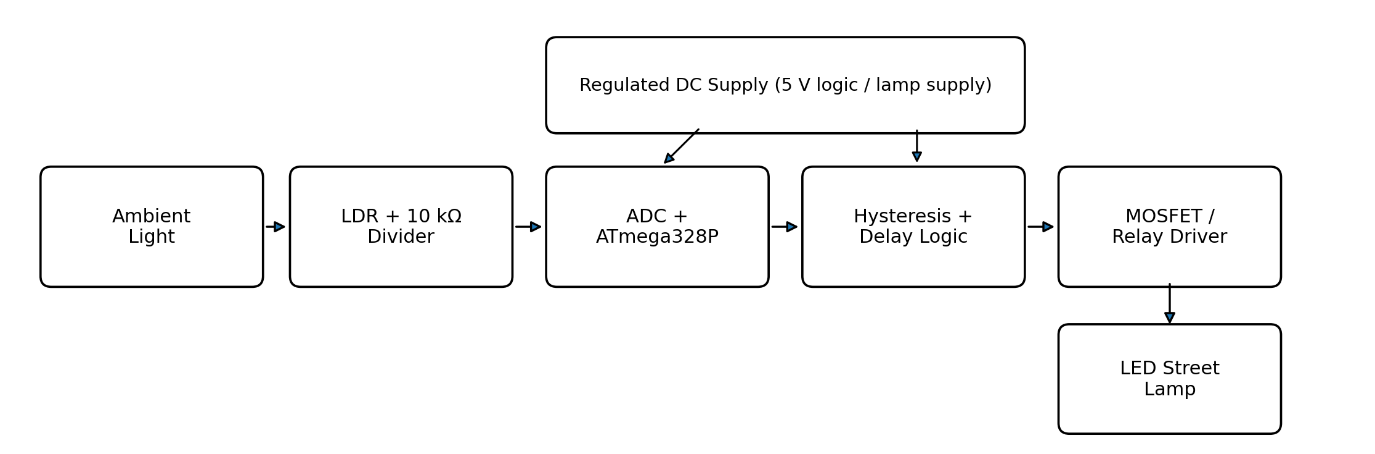
Street lighting is essential for road safety and public security, yet conventional switching practices can waste electricity when lamps remain energized after sunrise or are switched on before ambient illumination actually falls below a useful level. This methodology paper presents the design of a low-cost automatic street light control system using a light dependent resistor (LDR), an ATmega328P-class embedded controller, a switching driver, and an LED lamp. The proposed method converts ambient light variation into an analog voltage, samples the signal through the microcontroller analog-to-digital converter, and applies two switching thresholds with hysteresis and a short validation delay. The hysteresis prevents rapid lamp flicker around twilight, while the delay rejects brief disturbances caused by vehicle headlights, shadows, or lightning. The design emphasizes simplicity, low component count, independent operation, and ease of retrofitting. A circuit-level prototype/simulation procedure is defined for daylight, dusk, night, and disturbance conditions. The resulting logic provides correct OFF operation in high illumination and ON operation under low illumination, with stable transition behavior across the uncertain twilight region. A normalized daily energy estimate shows that the principal saving of a simple LDR system comes from eliminating avoidable daytime operation and seasonal timer mismatch, while larger savings require dimming or traffic-aware control. The study concludes that LDR-based control is an appropriate low-cost first stage for automatic street lighting and can later be extended with motion sensing, dimming, communication, or fault monitoring.