A Survey of Methods and Architectures for LightConneuNet: Potential Analysis of Fuel Cell Vehicle-To-Grid System with Large-Scale Buildings
DOI:
https://doi.org/10.65521/itsi-teee.v12i1.3884Keywords:
Abstract
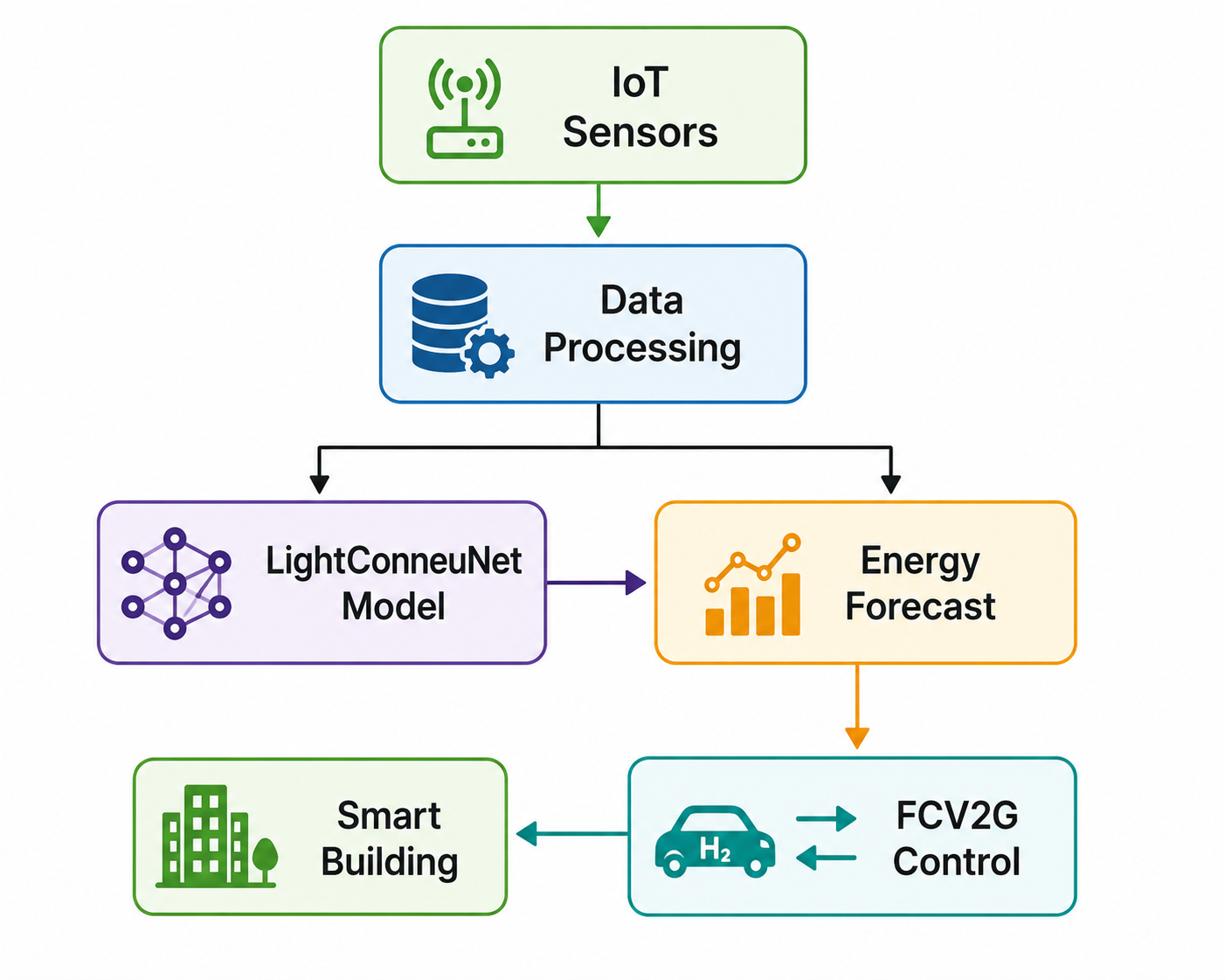
The global transition toward decarbonized energy systems has intensified interest in integrating hydrogen fuel cell technologies, intelligent neural networks, and large-scale building energy infrastructure. Fuel cell vehicle-to-grid (FCV2G) systems enable hydrogen-powered vehicles to act as distributed energy resources, supporting grid stability, peak demand management, and renewable energy integration. However, these systems introduce complex, multi-scale optimization challenges requiring efficient and adaptive computational frameworks. This paper presents a systematic review of LightConneuNet architectures for FCV2G-based building energy management. LightConneuNet combines depthwise separable convolutions, attention mechanisms, and dense connectivity to achieve high predictive accuracy with low computational overhead, making it suitable for real-time and edge deployment. The review examines its application in demand forecasting, state-of-health estimation, hydrogen energy management, and bidirectional power flow optimization, supported by advanced optimization techniques and multi-task learning strategies. Applications span commercial buildings, campuses, and smart residential systems integrated with hydrogen infrastructure and renewable energy sources. Empirical findings demonstrate improved performance in accuracy, latency, and scalability compared to conventional deep learning models. Despite these advancements, challenges such as data availability, uncertainty quantification, and system integration remain. This review highlights the potential of lightweight deep learning architectures in enabling intelligent, scalable, and sustainable FCV2G energy management systems.