Recent Advances in Energy Management in Microgrids: A Hybrid Human Evolutionary Optimization Algorithm for Grid-Isolated Electric Vehicle Charging Systems: A Systematic Review
DOI:
https://doi.org/10.65521/itsi-teee.v12i2.3901Keywords:
Abstract
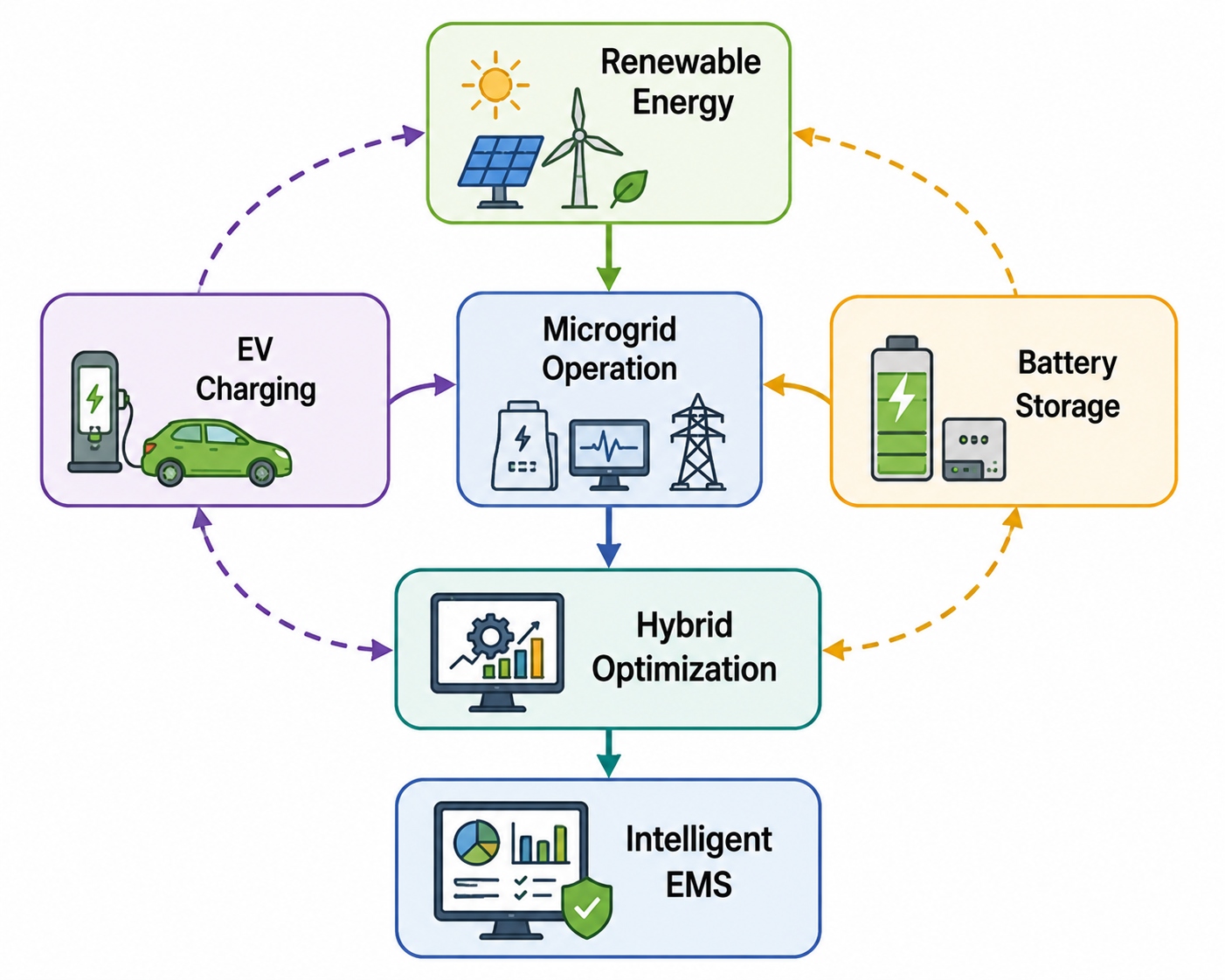
The rapid integration of renewable energy sources (RES), electric vehicles (EVs), and distributed energy resources (DERs) has transformed modern power systems, particularly within decentralized microgrid environments. Although microgrids enhance energy flexibility, reliability, and sustainability, their operation is challenged by intermittent renewable generation, uncertain EV charging demands, and dynamic load variations. Consequently, intelligent Energy Management Systems (EMS) have become essential for optimizing resource utilization and maintaining system stability. Recent advances in artificial intelligence, evolutionary computation, and hybrid metaheuristic optimization have demonstrated significant potential in addressing these challenges. This systematic review comprehensively examines recent developments in microgrid energy management, with particular emphasis on grid-isolated EV charging systems and hybrid human evolutionary optimization algorithms. Existing studies are categorized according to optimization techniques, objective functions, and system architectures, enabling a detailed comparative analysis of current methodologies. The review highlights that hybrid optimization approaches consistently outperform conventional algorithms in minimizing operational cost, reducing emissions, improving energy efficiency, and enhancing scheduling performance. Furthermore, integrating battery energy storage systems and intelligent control strategies substantially improves system resilience and reliability. Finally, the review identifies key research gaps, including scalability, real-time implementation, uncertainty handling, and adaptive optimization, and outlines future directions for developing intelligent, sustainable, and energy-efficient microgrid energy management frameworks.