Artificial Intelligence Techniques for Optimal Scheduling of PV-Battery-Electric Vehicle Loads Using a Scalable Quantum Non-Local Neural Network Approach: Trends and Challenges
DOI:
https://doi.org/10.65521/itsi-teee.v12i1.3876Keywords:
Abstract
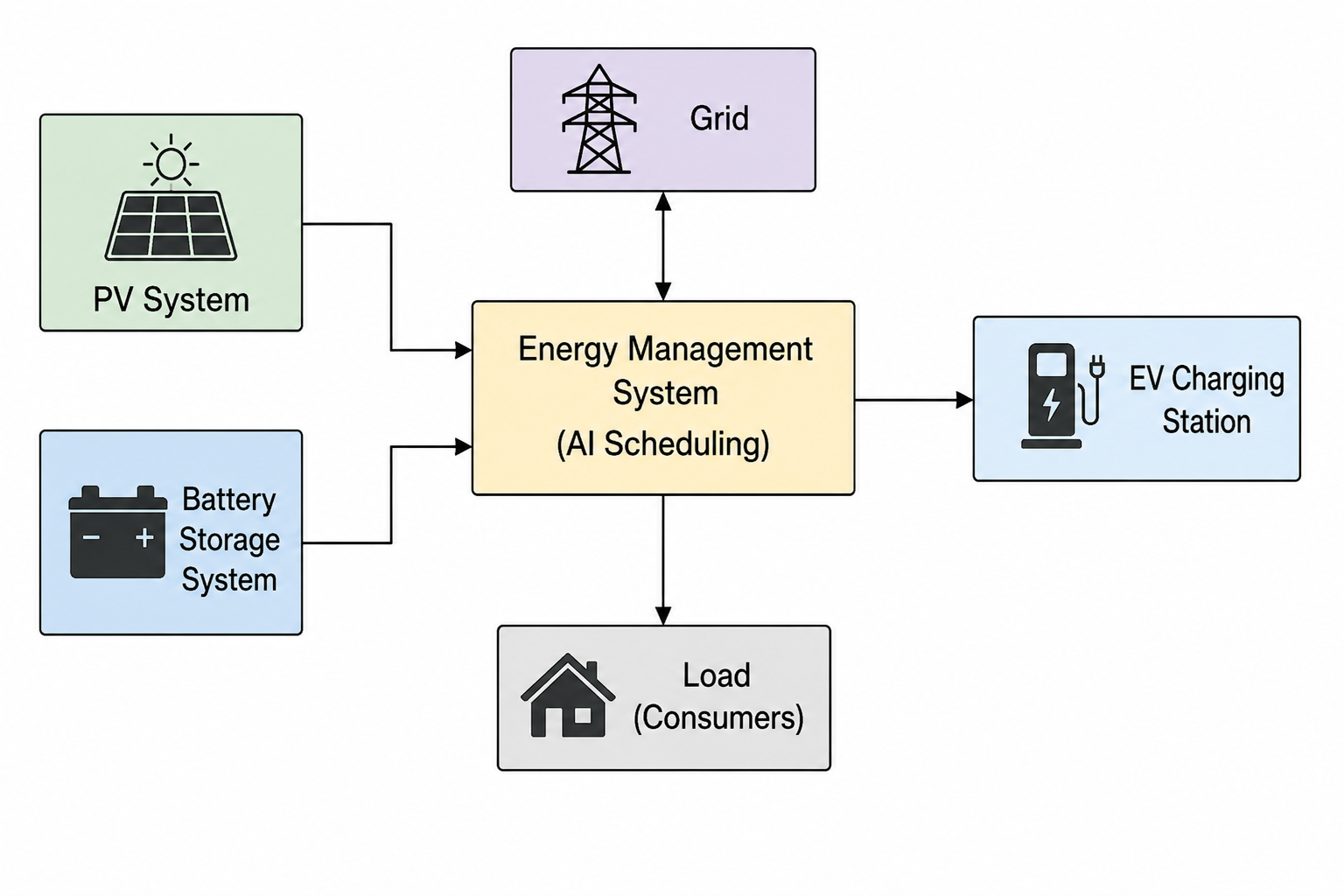
The global transition toward sustainable energy systems has accelerated the integration of photovoltaic (PV) systems, battery energy storage systems (BESS), and electric vehicles (EVs) into modern smart grids. While these technologies enable decentralized and flexible energy management, they also introduce significant challenges due to renewable intermittency, stochastic demand, and complex system interactions. Traditional optimization methods often struggle with scalability and uncertainty, necessitating advanced artificial intelligence (AI)-based approaches. This review presents a comprehensive analysis of AI-driven techniques for optimal scheduling in PV-battery-EV systems, with a focus on scalable quantum non-local neural networks (QNLNN). These models enhance traditional deep learning by capturing global dependencies and leveraging quantum-inspired optimization to improve solution efficiency and convergence. The study examines various deep learning architectures, including CNNs, RNNs, LSTM, GNNs, and transformer-based models, integrated with optimization strategies for energy scheduling. It also highlights the role of IoT, edge-cloud computing, and simulation platforms in enabling real-time decision-making. Findings indicate that QNLNN-based approaches significantly improve cost efficiency, renewable energy utilization, and grid stability. Key challenges such as data limitations, computational complexity, and system integration are discussed, along with future research directions for scalable and intelligent energy management systems.