Recent Advances in Energy Management in Smart Grids Using IoT and Price-Based Demand Response with a Hybrid FHO-RERNN Approach: A Systematic Review
DOI:
https://doi.org/10.65521/itsi-teee.v13i2.3867Keywords:
Abstract
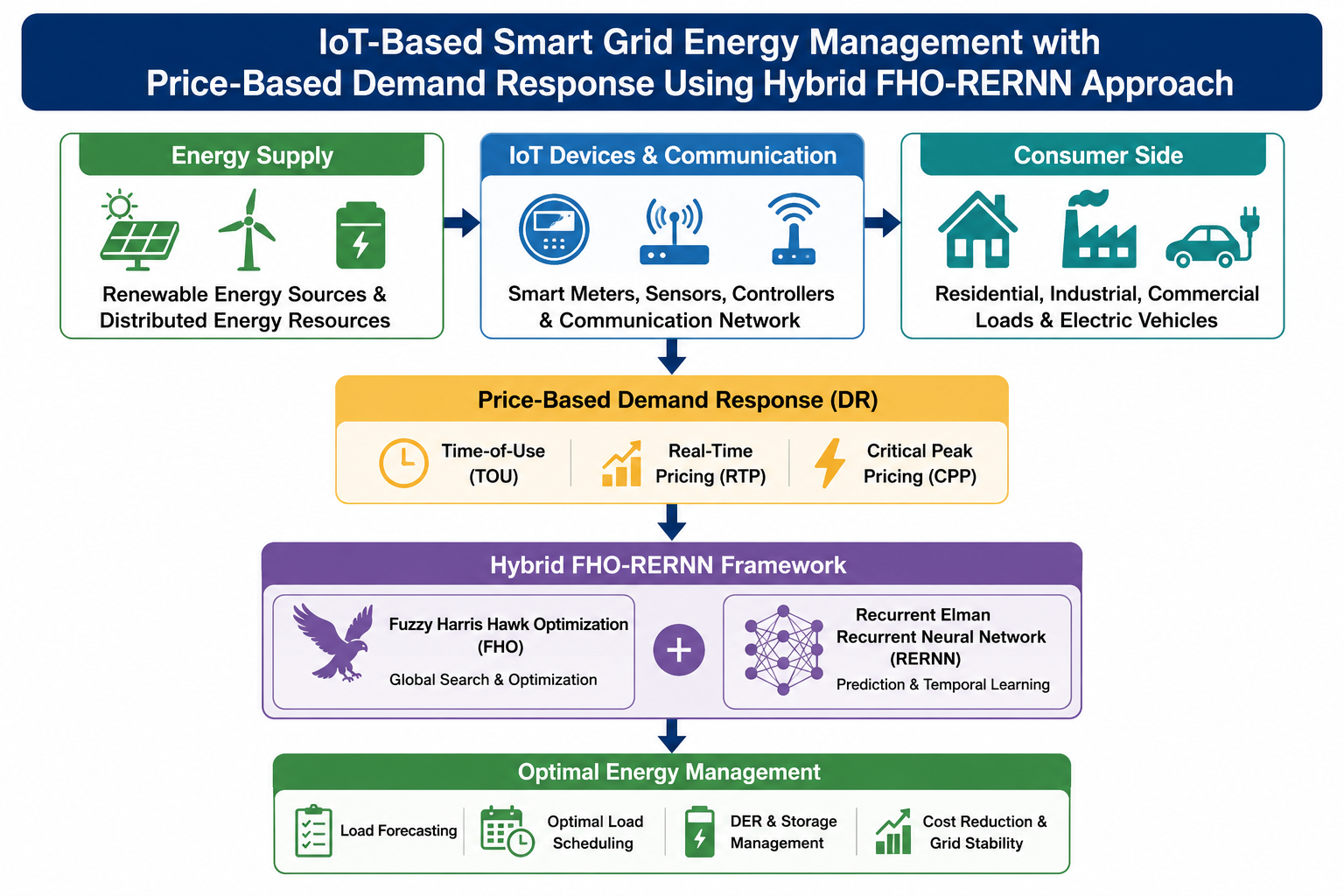
Smart grids have transformed conventional power systems by integrating advanced communication technologies, distributed energy resources, and intelligent control mechanisms to achieve efficient, reliable, and sustainable energy management. Among these technologies, the Internet of Things (IoT) enables real-time monitoring, bidirectional communication, and automated control of energy assets, while price-based demand response (DR) programs encourage consumers to optimize electricity consumption through dynamic pricing schemes such as time-of-use, real-time pricing, and critical peak pricing. The increasing penetration of renewable energy sources, uncertain load demand, and complex grid dynamics has created the need for intelligent optimization methods capable of addressing nonlinear, stochastic, and multi-objective energy management problems beyond the capabilities of conventional algorithms. This systematic review examines recent advances in IoT-enabled smart grid energy management with particular emphasis on the Hybrid FHO-RERNN (Fuzzy Harris Hawk Optimization–Recurrent Elman Recurrent Neural Network) framework. The FHO algorithm provides efficient global optimization for energy scheduling and resource allocation, while the RERNN accurately models temporal dependencies in electricity demand and renewable generation. Their integration enhances forecasting accuracy, convergence speed, computational efficiency, and demand response performance across residential, industrial, and microgrid environments. The reviewed studies demonstrate that combining IoT infrastructures, intelligent demand response strategies, and hybrid optimization techniques significantly improves grid stability, renewable energy utilization, operational cost reduction, and overall energy efficiency. Despite these advances, challenges related to scalability, cybersecurity, interoperability, data privacy, and real-time implementation remain. Future research should focus on developing explainable, privacy-preserving, and scalable AI-driven energy management frameworks for resilient next-generation smart grids.