Deep Learning and Optimization Approaches in Multi-Attack Detection using Forensics and Coherent Integrated Photonic Neural Networks-based Prevention for Secure IoT-MANETs: A Review
DOI:
https://doi.org/10.65521/itsi-teee.v14i2.2830Keywords:
Abstract
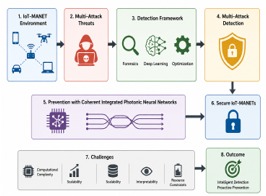
The increasing adoption of Internet of Things (IoT) and Mobile Ad Hoc Networks (MANETs) has introduced critical security challenges due to their distributed architecture and resource constraints. These networks are highly susceptible to multi-vector cyberattacks, including Distributed Denial of Service (DDoS), botnet, black hole, and wormhole attacks. Traditional intrusion detection systems (IDS) are inadequate for detecting complex and evolving threats. Recent advancements in deep learning and optimization techniques have significantly improved multi-attack detection capabilities. Deep learning models such as Convolutional Neural Networks (CNN), Long Short-Term Memory (LSTM), autoencoders, and graph neural networks have demonstrated superior performance in analyzing network traffic patterns and detecting anomalies. These models can extract hierarchical features and capture temporal dependencies, enabling accurate classification of multi-stage attacks. Additionally, hybrid optimization techniques enhance detection performance by tuning model parameters and improving convergence efficiency. Network forensics plays a crucial role in analyzing attack patterns and identifying attack sources, while coherent integrated photonic neural networks enable ultra-fast data processing for real-time detection. These technologies together provide a robust framework for secure IoT-MANET environments. This review presents recent advances in deep learning and optimization-based intrusion detection systems, highlighting trends, comparative insights, challenges, and future directions.