A Survey of Methods and Architectures for Deep Hyperbolic graph attention network-based collaborative routing algorithm for clustered IoT-MANETs
DOI:
https://doi.org/10.65521/itsi-teee.v14i2.2831Keywords:
Abstract
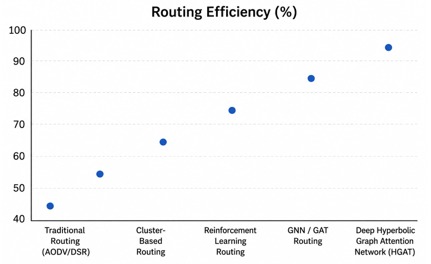
The rapid growth of Internet of Things (IoT) technologies has created highly dynamic communication environments such as Mobile Ad Hoc Networks (MANETs). In clustered IoT-MANET systems, routing remains a major challenge because of node mobility, changing network topology, limited bandwidth, and energy constraints. Conventional routing protocols often fail to provide reliable and scalable communication in such complex environments. To overcome these limitations, researchers have increasingly focused on artificial intelligence and deep learning approaches for intelligent routing optimization. Graph-based learning models, including Graph Neural Networks (GNNs) and Graph Attention Networks (GATs), are highly effective in representing network structures and learning relationships among connected nodes. Hyperbolic graph learning further improves these models by efficiently capturing hierarchical and large-scale network characteristics. The integration of hyperbolic representations with attention mechanisms enables adaptive and collaborative routing decisions with improved packet delivery, lower latency, and better energy efficiency. This survey examines recent architectures and methods for Deep Hyperbolic Graph Attention Network-based collaborative routing in clustered IoT-MANETs while discussing routing strategies, clustering approaches, optimization methods, key challenges, and future research directions for scalable intelligent communication systems.