A Survey of Methods and Architectures for Graph Neural Networks with Optimized Attention and Long-Range CNN for Traffic Prediction and Resource Allocation in 6G Wireless Systems
DOI:
https://doi.org/10.65521/itsi-teee.v14i1.2819Keywords:
Abstract
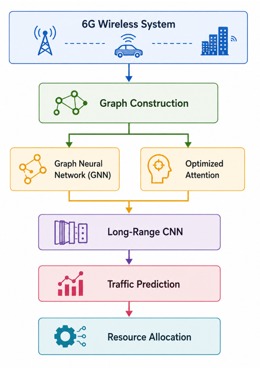
The rapid evolution of 6G wireless systems has intensified the demand for intelligent traffic prediction and efficient resource allocation mechanisms to support ultra-reliable, low-latency, and high-capacity communication. Traditional machine learning models fail to effectively capture the complex spatial–temporal dependencies present in large-scale wireless and vehicular networks. Recently, Graph Neural Networks (GNNs), combined with optimized attention mechanisms and long-range Convolutional Neural Networks (CNNs), have emerged as powerful tools for modelling such dynamic systems. GNNs are particularly effective in representing traffic networks due to their ability to model relationships among nodes such as roads, base stations, and vehicles. This survey reviews recent methods and architectures developed in recent years, focusing on hybrid models integrating GNNs, attention mechanisms, and long-range CNNs for traffic prediction and resource allocation in 6G environments. The study highlights advancements in spatial–temporal graph learning, attention-based feature optimization, and reinforcement learning integration. Additionally, it discusses challenges such as scalability, computational complexity, and real-time deployment. The survey provides a comparative analysis of existing approaches and identifies future research directions for designing efficient, intelligent, and adaptive 6G wireless systems.