A Survey of Methods and Architectures for Resource allocation via Sparsity-Aware Orthogonal Initialization of Deep Neural Networks in free space optical communications
DOI:
https://doi.org/10.65521/itsi-teee.v12i2.3895Keywords:
Abstract
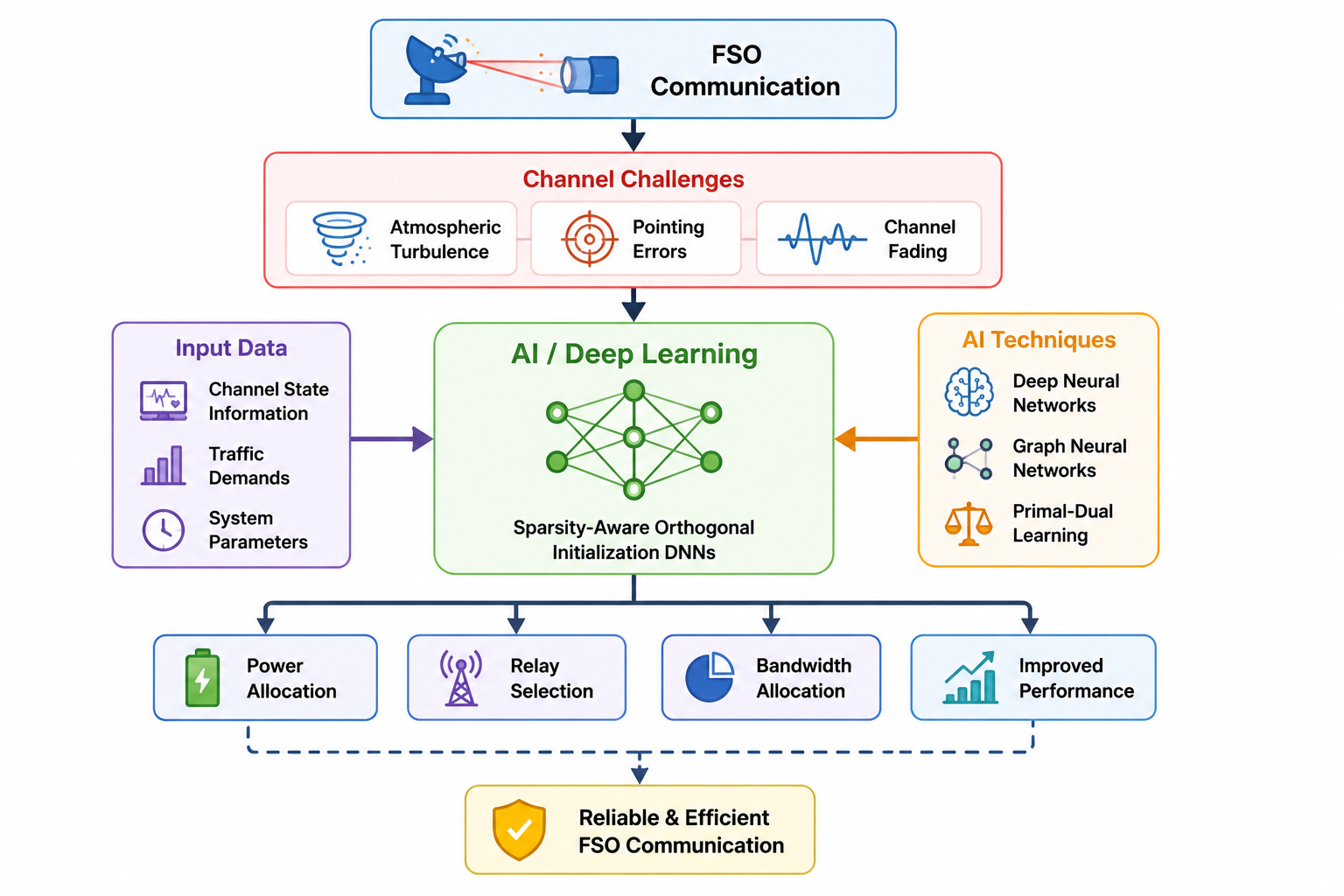
Free Space Optical (FSO) communication has emerged as a promising technology for next-generation wireless networks because of its high bandwidth, license-free spectrum, low latency, and secure data transmission. However, atmospheric turbulence, fog, pointing errors, and channel fading significantly degrade communication quality, making efficient resource allocation a critical requirement for reliable system performance. Recent advances in Artificial Intelligence (AI) and Deep Neural Networks (DNNs) have enabled adaptive, data-driven resource allocation strategies that outperform conventional optimization methods in dynamic FSO environments. Among these techniques, sparsity-aware orthogonal initialization has gained considerable attention for improving training stability, accelerating convergence, enhancing feature representation, and mitigating vanishing and exploding gradient problems. By promoting sparse and informative feature learning, these models achieve better computational efficiency and generalization under stochastic channel conditions. Moreover, advanced deep learning architectures, including convolutional neural networks, graph neural networks, and primal-dual learning frameworks, have demonstrated remarkable capabilities in optimizing power allocation, relay selection, bandwidth management, and network control without relying on explicit mathematical channel models. This survey comprehensively reviews recent methods and architectures for AI-driven resource allocation in FSO communication systems, compares existing approaches, identifies key research challenges, and outlines future directions for developing scalable, intelligent, and resilient optical wireless communication networks.