Recent Advances in Resource Allocation with Efficient Task Scheduling in Cloud Computing Using Hierarchical Auto-Associative Polynomial Convolutional Neural Network: A Systematic Review
DOI:
https://doi.org/10.65521/itsi-teee.v12i2.3891Keywords:
Abstract
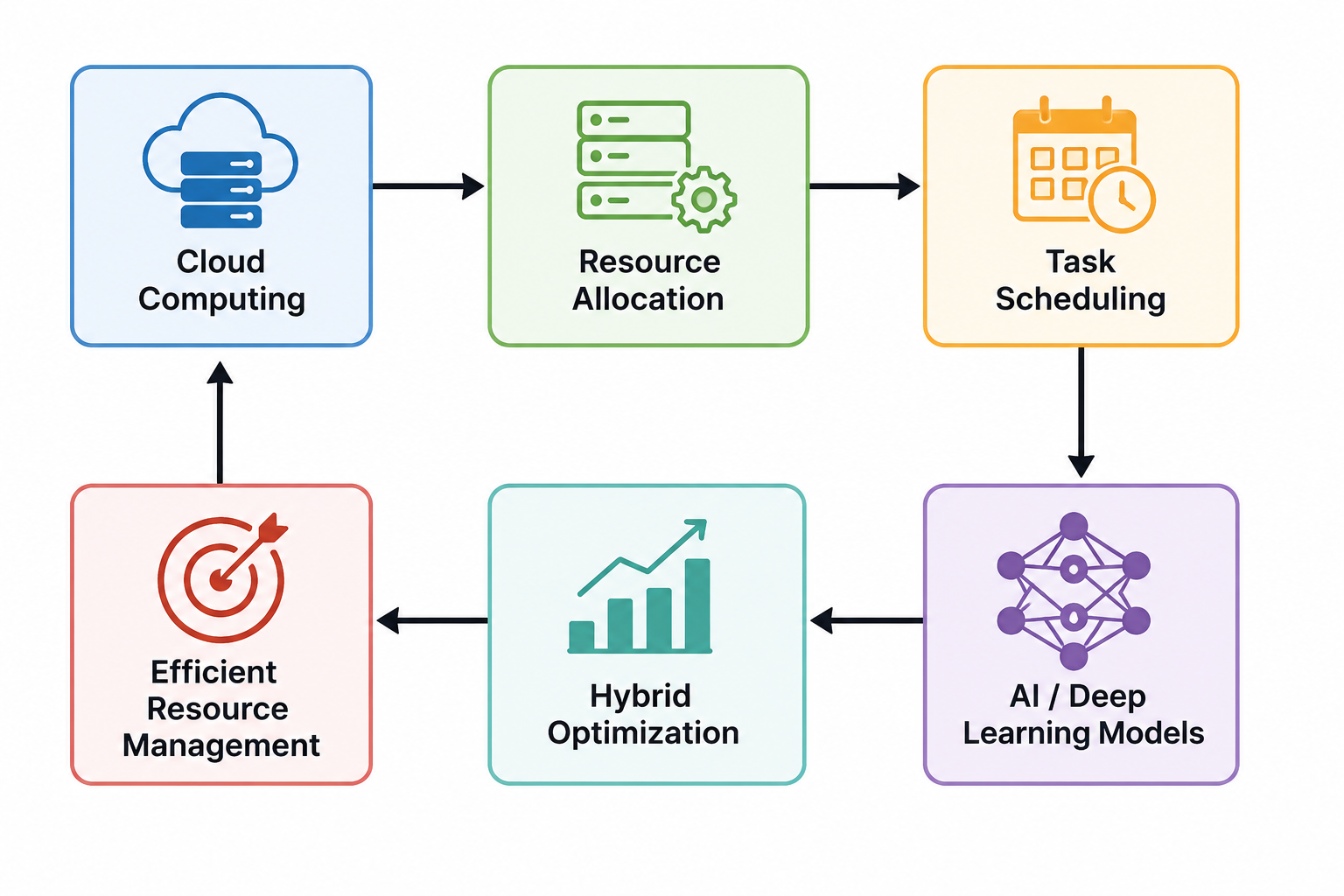
Cloud computing has emerged as a dominant paradigm for delivering scalable, on-demand computing resources. Efficient resource allocation and task scheduling are critical challenges in cloud environments due to the dynamic nature of workloads, heterogeneous resources, and quality of service (QoS) requirements. Traditional scheduling algorithms often fail to achieve optimal performance in terms of resource utilization, execution time, and energy efficiency. Recently, Artificial Intelligence (AI) and deep learning-based approaches, particularly convolutional neural networks (CNNs) and hybrid optimization techniques, have shown significant potential in addressing these challenges. This systematic review focuses on recent advances in resource allocation and task scheduling using hierarchical auto-associative polynomial convolutional neural networks (HAPCNN) and related intelligent optimization techniques. The integration of deep learning with metaheuristic algorithms has improved scheduling efficiency by minimizing make span and maximizing throughput. For instance, CNN-based optimization approaches have demonstrated enhanced performance in reducing response time and improving resource utilization. Moreover, recent studies highlight the importance of hybrid frameworks combining machine learning, reinforcement learning, and heuristic optimization for dynamic resource allocation. Despite these advancements, challenges such as scalability, energy efficiency, and real-time adaptability persist. This review provides a comprehensive analysis of recent methodologies, identifies research gaps, and outlines future directions for intelligent cloud resource management systems.