Artificial Intelligence Techniques for Smart Healthcare Patient Monitoring System for IoT-Based Healthcare System Using Enhanced Residual Multi-Scale Diverged Self-Attention Network: Trends and Challenges
DOI:
https://doi.org/10.65521/itsi-teee.v14i1.2816Keywords:
Abstract
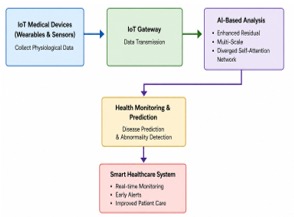
The integration of Artificial Intelligence (AI) with Internet of Things (IoT)-based healthcare systems has significantly transformed patient monitoring by enabling real-time data acquisition, intelligent decision-making, and predictive diagnostics. Smart healthcare systems utilize wearable sensors, wireless body area networks (WBAN), and cloud-edge infrastructures to continuously monitor physiological parameters such as heart rate, blood pressure, oxygen saturation, and electrocardiogram (ECG) signals. These systems generate large volumes of heterogeneous data, necessitating advanced analytical techniques for efficient processing. Recent advancements in deep learning, particularly convolutional neural networks (CNN), recurrent neural networks (RNN), and attention-based architectures, have improved the accuracy and efficiency of patient monitoring systems. Self-attention mechanisms and multi-scale feature extraction techniques enhance the ability to capture complex temporal and spatial dependencies in medical data. Studies show that AI-enabled IoT healthcare systems can achieve predictive accuracies between 85% and 95%, significantly improving diagnostic performance and clinical decision-making. This paper presents a systematic review of recent developments in AI-driven IoT-based healthcare monitoring systems, focusing on enhanced residual multi-scale diverged self-attention networks. The review analyses various methodologies based on accuracy, scalability, latency, and computational efficiency. Furthermore, challenges such as data privacy, energy consumption, interoperability, and security are discussed. Finally, future research directions including federated learning, edge intelligence, and attention-based architectures are highlighted.