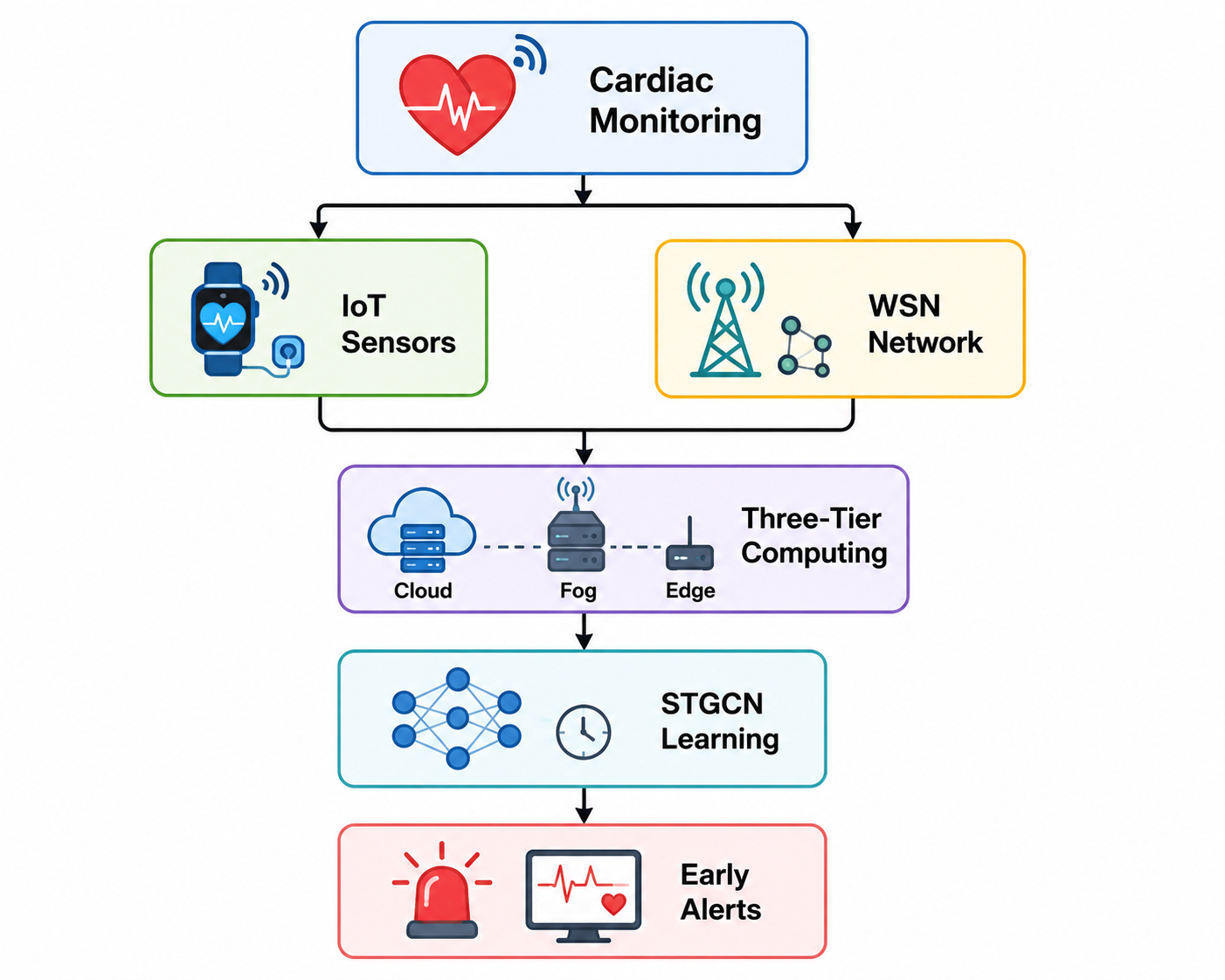
Deep Learning and Optimization Approaches for IoT-Based Three-Tier Cardiac Monitoring Using Spatio-Temporal Graph Convolutional Networks
DOI:
https://doi.org/10.65521/itsi-teee.v12i2.3894Keywords:
Abstract
Continuous cardiac health monitoring has become a critical requirement in modern healthcare systems, particularly with the increasing prevalence of cardiovascular diseases. The integration of Internet of Things (IoT) and Wireless Sensor Networks (WSNs) has enabled real-time acquisition and transmission of physiological signals such as ECG, heart rate, and blood pressure. This paper presents a comprehensive review of deep learning and optimization approaches applied to a three-tier architecture for cardiac monitoring systems, incorporating edge, fog, and cloud layers. Spatio-Temporal Graph Convolutional Neural Networks (STGCNs) have emerged as a powerful framework for modelling complex relationships in time-series health data by capturing both spatial dependencies between sensor nodes and temporal variations in physiological signals. These models effectively address limitations of traditional deep learning approaches by operating on non-Euclidean data structures. The review highlights the role of optimization techniques such as model compression, edge computing, and energy-aware routing in improving system efficiency and scalability. Furthermore, the three-tier architecture enhances system performance by distributing computation across edge devices, fog nodes, and cloud servers. The study identifies key challenges, including data heterogeneity, latency, and computational complexity, and emphasizes the need for hybrid frameworks integrating STGCN with optimization strategies. The findings suggest that such integrated systems can significantly improve real-time cardiac monitoring and early alert generation.